SCOTUS Restores Alabama Map for 2026 Elections
High Court allows Alabama’s 2023 congressional map to return, setting up a new chapter in the State's redistricting battle
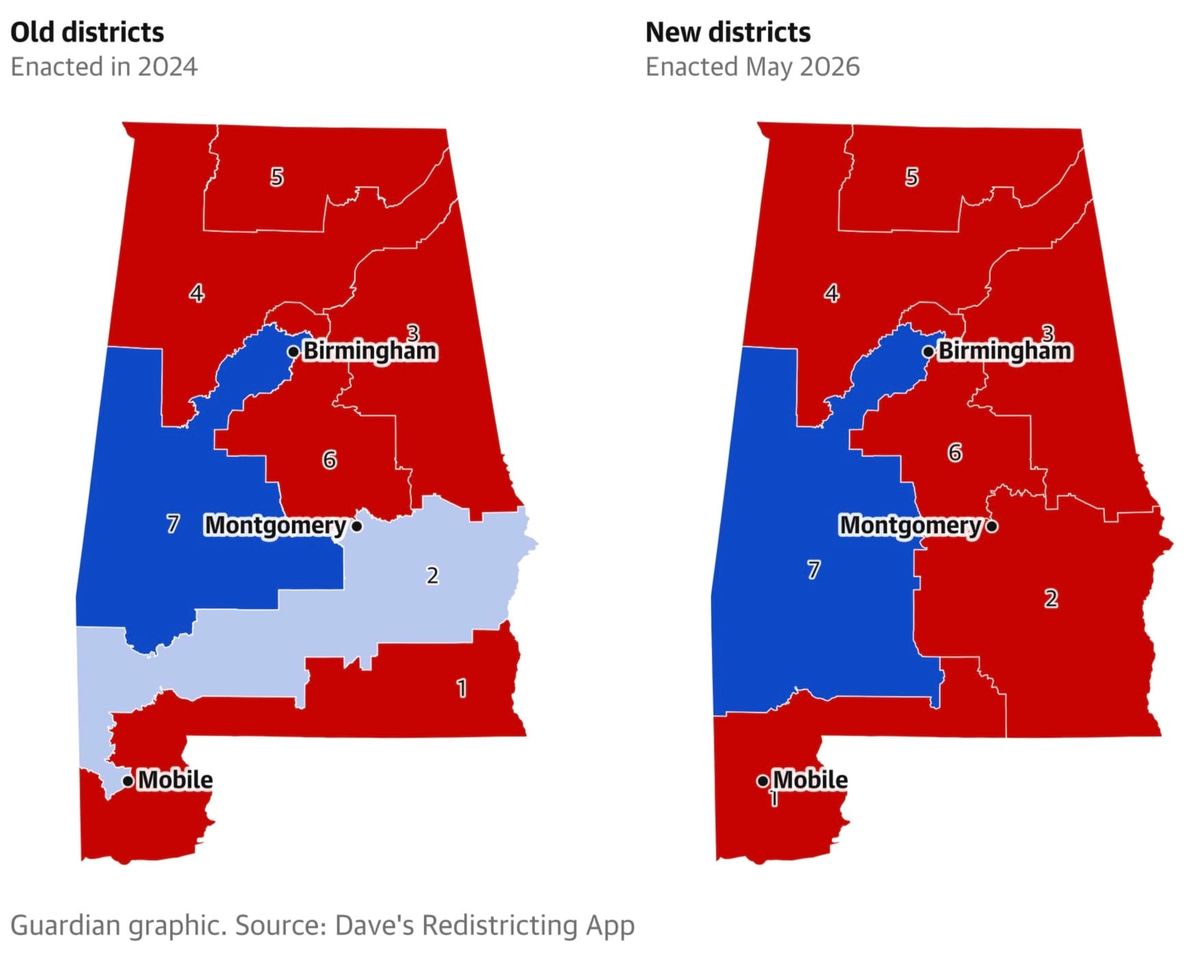
The U.S. Supreme Court on Tuesday cleared the way for Alabama to use its 2023 congressional map in the 2026 election cycle, marking the latest turn in a redistricting fight that has stretched from Montgomery to Washington and back again.
In a 6-3 decision, the Court granted Alabama's emergency request to reinstate the Legislature's map while legal challenges continue. The ruling effectively restores a map expected to produce a congressional delegation with six Republican-leaning districts and one Democratic-leaning district. The Court's three liberal justices dissented.
The decision comes just days after a three-judge federal panel ruled that Alabama's 2023 map was intentionally discriminatory and could not be used in upcoming elections. That panel included two judges appointed by President Donald Trump and one appointed by President Bill Clinton.
According to Reuters, the Supreme Court concluded that the lower court did not properly reconsider the case under the framework established in the Court's recent decision in Louisiana v. Callais. That April ruling significantly altered how federal courts evaluate claims under the Voting Rights Act and racial gerrymandering cases.
The latest order allows Alabama to move forward with the Legislature's preferred map while appeals continue.
The practical impact could be substantial.
The court-drawn map used in the 2024 election created two districts where Black voters had a realistic opportunity to elect candidates of their choice. That map led to the election of Democrat Shomari Figures in Alabama's 2nd Congressional District, alongside longtime Democratic Rep. Terri Sewell in the 7th District.
Under the Legislature's 2023 map, the 2nd District becomes considerably more favorable to Republicans. Political observers have widely viewed the district as a potential GOP pickup if the map remained in place for 2026.
The ruling represents another dramatic shift in a case that has become one of the nation's most closely watched voting rights disputes.
Following the 2020 Census, Alabama lawmakers approved a congressional map containing one majority-Black district out of seven. Civil rights groups and Black voters challenged the plan, arguing it unlawfully diluted Black voting strength despite African Americans making up more than one-quarter of the State's population.
In 2023, the Supreme Court surprised many court watchers when it upheld a lower court ruling in Allen v. Milligan and directed Alabama to create a second district where Black voters would have an opportunity to elect their preferred candidate.
After Alabama adopted a revised map that federal judges again found insufficient, a court-appointed special master drew the map ultimately used in the 2024 election.
That landscape changed in April when the Supreme Court issued its decision in Louisiana v. Callais. Legal analysts across the political spectrum viewed the ruling as narrowing the reach of the Voting Rights Act and raising the burden for plaintiffs challenging congressional maps on racial grounds.
The Court's latest order indicates the justices believe Alabama is likely to succeed in arguing that the lower court failed to apply those new standards correctly.

In a dissent cited by multiple national news organizations, Justice Sonia Sotomayor warned that the Court was allowing Alabama to proceed with a map that a lower court had found was enacted with discriminatory intent. She argued the decision would create confusion and disrupt election administration.
State leaders welcomed the ruling.
Governor Kay Ivey has consistently argued that Alabama's congressional maps were drawn according to traditional redistricting principles and that federal courts had improperly inserted themselves into the process.
“The U.S. Supreme Court confirmed what I have said all along and that is that Alabama knows our state, our people and our districts best,” Ivey posted on social media. “Today’s decision is a win for the people of Alabama and our elections. Alabama is doing our part to keep America strong, and I am proud our state continues to fight the fight to ensure activists do not get the final say. I will see y’all at the polls August 11!”
Attorney General Steve Marshall likewise maintained that the State's position was strengthened by the Court's Callais decision and urged the justices to intervene.
“Tonight’s decision is a major victory for Alabama and for the principle of self-governance. The United States Supreme Court confirmed what we always knew: that Alabama’s Congressional maps are constitutional and lawful under the Voting Rights Act. The Court's decision to stay the district court's injunction affirms that Alabama's elected representatives, not federal judges, have the primary authority to draw the maps under which Alabamians choose their own leaders,” Marshall said in a statement.
The legal fight, however, is not over.
The Supreme Court's order does not resolve the underlying claims. Instead, it allows Alabama to use the 2023 map while litigation continues in the lower courts. Those proceedings could determine whether the map ultimately survives future legal scrutiny.
For now, though, Alabama election officials will move ahead under district lines favored by Republican lawmakers, restoring a map that could reshape the State's congressional delegation and influence the battle for control of the U.S. House in 2026.