Second Circuit Affirms Right to Record Police
First Amendment ruling protects filming from public places but leaves room for lawful stops, ID demands and limits tied to real police work
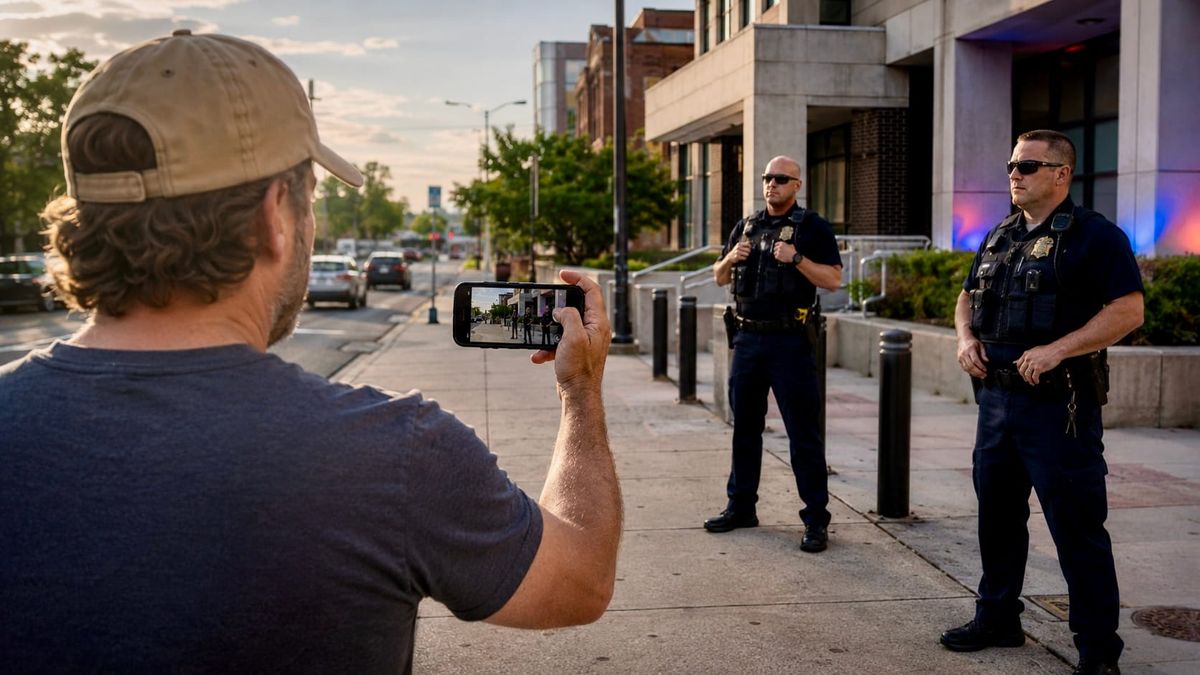
The U.S. Court of Appeals for the Second Circuit has affirmed what most Americans already believed: The First Amendment protects the right to record police in public.
The Aug. 17 ruling covers Connecticut, New York and Vermont, and brings the court in line with a growing number of federal appeals courts that have reached the same conclusion.
The court also held that the right also protects filming the outside of a police station from a public sidewalk — even though the man who brought the case still lost his lawsuit.
Keith Massimino, a self-described “First Amendment auditing hobbyist,” recorded the outside of the Waterbury Police Department in Connecticut on Oct. 30, 2018. His video included a youth division entrance and part of an open-air garage that held police vehicles.
Massimino stayed on a public sidewalk. After about six and a half minutes, officers Matthew Benoit and Frank Laone approached him.
Massimino said he was a journalist gathering material for a story, but he declined to answer more questions. The officers said filming the building posed a security concern. They also suspected that he might be planning an attack, according to the court’s opinion in Massimino v. Benoit.
The officers asked for identification. Massimino refused. They then called the demand a lawful order, and he refused again.
Police arrested him under Connecticut’s law against interfering with an officer. Massimino was held for several hours and released. The charge remained pending until it was dismissed in May 2021 — about two and a half years later.
Massimino then sued the officers. He claimed they violated his First Amendment right to record and his Fourth Amendment protection against an improper stop and arrest. He also brought a claim for malicious prosecution.
Judge Myrna Pérez, writing for the court, said the Second Circuit was joining “a growing chorus” of other federal appeals courts that have found a First Amendment right to record police work in public.
The court held that the right “encompasses Massimino’s recording of the exterior of a police station from a public sidewalk.”
Pérez drew a firm line between keeping sensitive areas out of public view and trying to stop people from recording what the government has left in plain sight.
“When the government wants to preserve its privacy, it may build a fence or close a door – but not ban speech,” Pérez wrote.
The ruling embraces what the ACLU of Connecticut called “plain-view parity.” In simple terms, if a person may lawfully stand in a public place and look at something, the government generally cannot ban that person from recording and sharing the same view.
The decision made the Second Circuit the ninth federal circuit court to recognize some form of the right to record police in public, according to The Free Thought Project.
Alabama residents have had the same core protection for more than 25 years.
In the 2000 case of Smith v. City of Cumming, the 11th Circuit held that people have a First Amendment right “to photograph or videotape police conduct,” and that “The First Amendment protects the right to gather information about what public officials do on public property, and specifically, a right to record matters of public interest.” The 11th Circuit covers Alabama, Florida and Georgia,
That right is subject to sound limits on time, place and manner. Recording does not grant a person the right to trespass, enter a closed area, block an officer, crowd an arrest or interfere with police work.
Although the Second Circuit recognized the right, it ruled that the protection had not been “clearly established” in that circuit when Massimino was arrested in 2018.
The officers therefore received qualified immunity from his First Amendment claim. That legal rule often shields public employees from personal liability unless earlier case law placed the alleged violation beyond reasonable debate.
The court also found that the officers had reasonable suspicion to detain Massimino briefly and question him. Once he refused their order to identify himself, the panel held that they had probable cause to believe he was violating Connecticut law.
Those findings defeated his Fourth Amendment and malicious-prosecution claims. The appeals court therefore upheld the lower court’s judgment for the officers, even as it established a broader First Amendment rule for future cases.
That makes the decision both a civil-liberty win and a hollow victory for Massimino. People in the Second Circuit now have clearer protection, but the ruling came too late to give him damages.
Connecticut General Statutes §53a-167a makes it a crime to obstruct, resist, hinder or endanger a peace officer or firefighter who is carrying out official duties.
The offense is normally a Class A misdemeanor. It becomes a Class D felony if the violation causes another person’s death or serious physical injury.
The law does not expressly say that all citizens must carry or display a photo ID. However, the Connecticut Supreme Court held in State v. Aloi that refusing to provide identification during a lawful investigative stop can amount to interference. The refusal need not include force or some other physical act if it hinders the lawful inquiry.
That reading proved crucial in Massimino’s case. The Second Circuit treated his refusal to comply with the ID order as a possible violation separate from the protected act of filming.
Alabama has no statute with the exact wording of Connecticut’s interference law. The closest match is Alabama Code §13A-10-2, which covers obstructing governmental operations.
A person commits that offense by using intimidation, physical force, interference or another act that is unlawful on its own to intentionally hinder government work or prevent a public servant from doing a government job. Like Connecticut’s basic offense, it is a Class A misdemeanor.
The two laws serve much the same goal, but their wording differs in key ways.
Connecticut broadly bars conduct that “obstructs, resists, hinders or endangers” an officer or firefighter. Its courts have held that passive refusal to identify oneself during a lawful stop may be enough.
Alabama’s obstruction law is more specific about the means used. It requires intimidation, physical force, interference or some other act that is already unlawful. It also states that the law does not apply to conduct that hinders the making of an arrest. Alabama handles resisting arrest under a separate law, §13A-10-41.
Alabama does, however, have its own stop-and-identify rule. Under Alabama Code §15-5-30, an officer may stop a person in public when the officer reasonably suspects that person has committed, is committing or is about to commit a felony or other public offense. The officer may then demand the person’s name, address and an explanation of his actions.
The vital phrase is “reasonably suspects.” Police cannot turn the mere act of recording from a lawful public place into a crime. There must be a valid legal basis for a detention, and any order issued during that stop must be lawful.
The public’s right is broad, but it is not a license to obstruct. A person may record police from a place where he has a right to be, so long as he keeps a safe distance and does not impede their work.
The Second Circuit’s message is still plain: Government may protect what is truly private. It may not expose its work to the public and then make recording that work a crime.