Senate Panel Votes to Hold Fauci in Contempt
Sen. Rand Paul sends Fauci case to DOJ after the former COVID adviser invoked the Fifth 111 times and refused to answer Senate questions
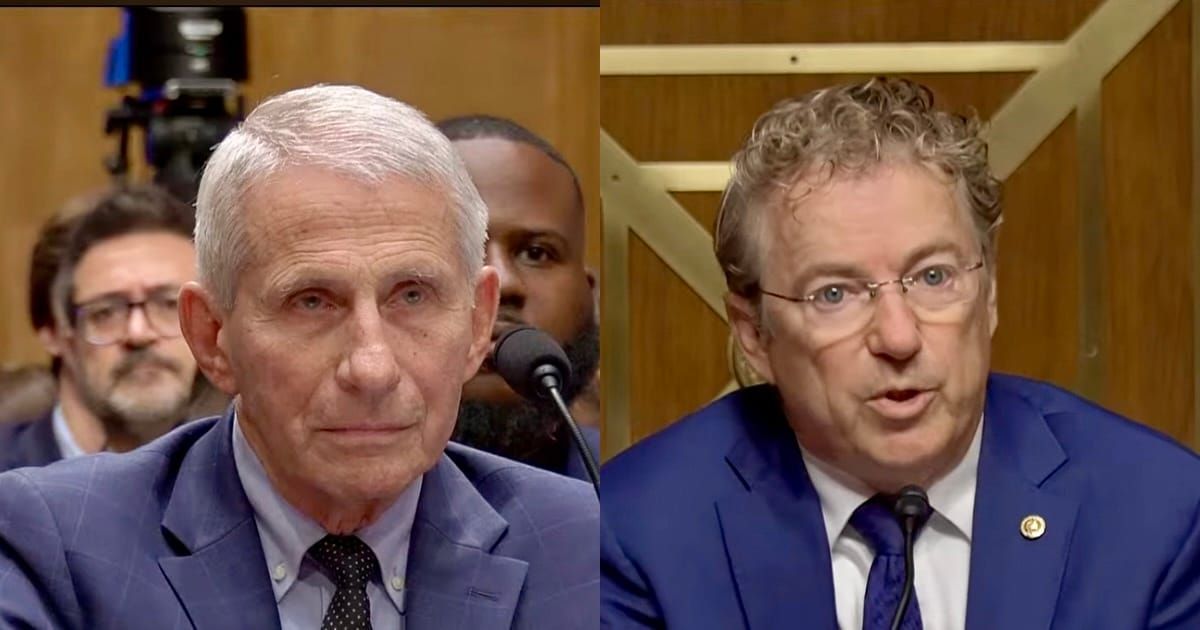
The Senate Homeland Security and Governmental Affairs Committee voted Thursday to hold Dr. Anthony Fauci in contempt of Congress after the former White House COVID adviser refused to answer questions under subpoena.
The Republican-led committee approved Chairman Rand Paul's contempt resolution on an 8-5 party-line vote. Paul (R-KY) is now taking the fight to the Department of Justice, where federal prosecutors will decide whether to pursue the matter.

The contempt vote came eight days after Fauci appeared before Paul's committee and invoked his Fifth Amendment right against self-incrimination in response to virtually every question lawmakers asked him.
According to Paul, Fauci invoked the Fifth 111 times.
"Holding a witness in contempt is a serious thing, and it should be rare," Paul said as the committee met Thursday. "But the contempt power exists for precisely this circumstance."
Paul said the issue before the committee was not Fauci's handling of COVID-19 or his views on public health policy. Instead, he framed the vote as a test of Congress' power to compel testimony from a witness who had already received a broad federal pardon.
"We only have one question: Whether to hold a witness responsible for his contempt toward Congress," Paul said. "The witness had many chances to answer the questions pertinent to our investigation, and he made his decision 111 times."
Paul also tied the vote to the enormous cost the pandemic and the government's response imposed on the nation.
"More than a million Americans died from COVID-19. Many of them died alone. Workers were forced to choose between a mandate and a job they needed. Businesses closed and never reopened. Children lost years of school they will never get back. Americans lost the freedom to work, to worship, and to decide what went into their own bodies. Nothing we do today can undo those losses. But silence does not honor them either. The American people deserve answers," Paul said.
As previously reported by ALPolitics.com, Fauci appeared before the committee July 29 under subpoena as part of its probe into the origins of COVID-19, U.S. funding for virus research and the government's response to the pandemic.
Fauci declined to answer questions about the origin of the virus, National Institutes of Health grants, his talks with other scientists, pandemic policy and entries in his own diary. He even invoked the Fifth when Senators asked basic questions designed to test the scope of his refusal.
The Fifth Amendment protects a witness from being forced to give testimony that could be used against him in a criminal case. Invoking the right is not, by itself, an admission of guilt.
Fauci said he acted on the advice of his attorneys and accused Paul of pursuing a personal campaign against him.
"The only conclusion I can reach is that the sole reason he is calling me before this committee is to get me to say something, anything, that could vindicate his repeated public pledges that I end up, in his words, quote, 'behind bars,'" Fauci said.
Paul argues the situation is different because President Joe Biden gave Fauci a sweeping preemptive pardon before leaving office. Paul contends that the pardon removed or sharply reduced Fauci's risk of federal prosecution for acts covered by it, weakening his Fifth Amendment claim.
Fauci's lawyers disagree and maintain that he remains on solid legal ground in asserting his constitutional right. Paul himself has acknowledged that the scope of Fauci's Fifth Amendment protection presents a legal question that may ultimately have to be settled in court.
Democrats on the committee opposed the resolution and sought to delay or block Thursday's vote.
Sen. Gary Peters (D-MI), the committee's ranking Democrat, warned that the action could damage the panel's ability to conduct oversight in the future.
"Criminal contempt is punitive. It does not compel a witness to answer questions or produce the documents we'd all like to see," Peters said. "What it will do is create a damaging precedent that future witnesses will use to resist legitimate congressional oversight and weaken this committee's ability to compel testimony."
Fauci attorney David Schertler was even more direct, calling the vote "a crude political stunt intended to punish Dr. Fauci for exercising his constitutional rights."
"Today's resolution is a continuation of Senator Paul's personal vendetta against Dr. Fauci, who spent 50 years in public health and has saved countless lives," Schertler said. "It is shameful and wrong that Senator Paul is abusing his power by trying to weaponize the Justice Department against an honorable public servant."
The contempt fight is the latest chapter in a bitter dispute between Paul and Fauci that dates to the pandemic.
Paul has repeatedly accused Fauci of misleading Congress about U.S. funding that flowed through EcoHealth Alliance to coronavirus research at the Wuhan Institute of Virology. Fauci has denied lying to Congress and has long disputed Paul's description of the work as prohibited gain-of-function research.
The issue gained new life this summer after the Office of the Director of National Intelligence released records alleging that Fauci, while leading the National Institute of Allergy and Infectious Diseases, provided millions of dollars in U.S. funds for risky coronavirus research connected to the Wuhan lab.
The exact origin of SARS-CoV-2 remains disputed. U.S. intelligence agencies have reached different conclusions, often with low confidence, while a House investigation concluded that a lab-related incident was the most likely origin.
Paul previously referred Fauci to the Justice Department in 2023 for possible prosecution over testimony concerning gain-of-function research and later renewed his call for an investigation. No charges resulted from those earlier referrals.
The issue has also drawn Sen. Tommy Tuberville (R-AL) into the fight.
Following Fauci's July testimony, Tuberville told Newsmax that he believes Fauci should face prosecution and suggested Alabama could examine whether State charges are possible if federal prosecution is blocked.
"Yeah, absolutely. He's guilty. He knows he's guilty. He got pardoned by President Biden. Of course, President Trump came out today and said, 'I'm gonna leave that pardon alone.' I don't know whether that's good or bad. I don't know what happened there."
Tuberville then said that, if elected Governor, he would explore whether Alabama could bring Fauci before a State court.
"Hopefully, in the next six months I'll be the Governor of Alabama, and I promise you one thing: We will find out if there's a possibility that we can bring him to Alabama to put him in front of a court and a jury to see if we can put this guy in prison."
Whether Alabama would have jurisdiction or a viable criminal charge remains an open question. Tuberville did not cite a specific Alabama law that Fauci allegedly violated.
Ordinarily, a congressional contempt resolution approved by a committee would move to the full Senate. Paul, however, is seeking to bypass that step and take the committee's findings directly to federal prosecutors.
"We will send it to the Department of Justice tomorrow so there's no delay," Paul told reporters before Thursday's vote. "That will be a committee recommendation."
CBS News reported Thursday evening that a congressional aide confirmed the referral had been sent to the Justice Department. The resolution calls for the matter to be certified to the U.S. Attorney for the District of Columbia.
That does not mean Fauci will be automatically charged, much less convicted. The decision on whether the former health official's refusal to testify amounts to criminal contempt — and whether his use of the Fifth Amendment was legally protected — now rests with federal prosecutors and potentially the courts.