Fauci Pleads Fifth at Rand Paul COVID Hearing
The former health chief refused to answer more than 100 questions as senators clashed over COVID origins, records and Biden’s pardon
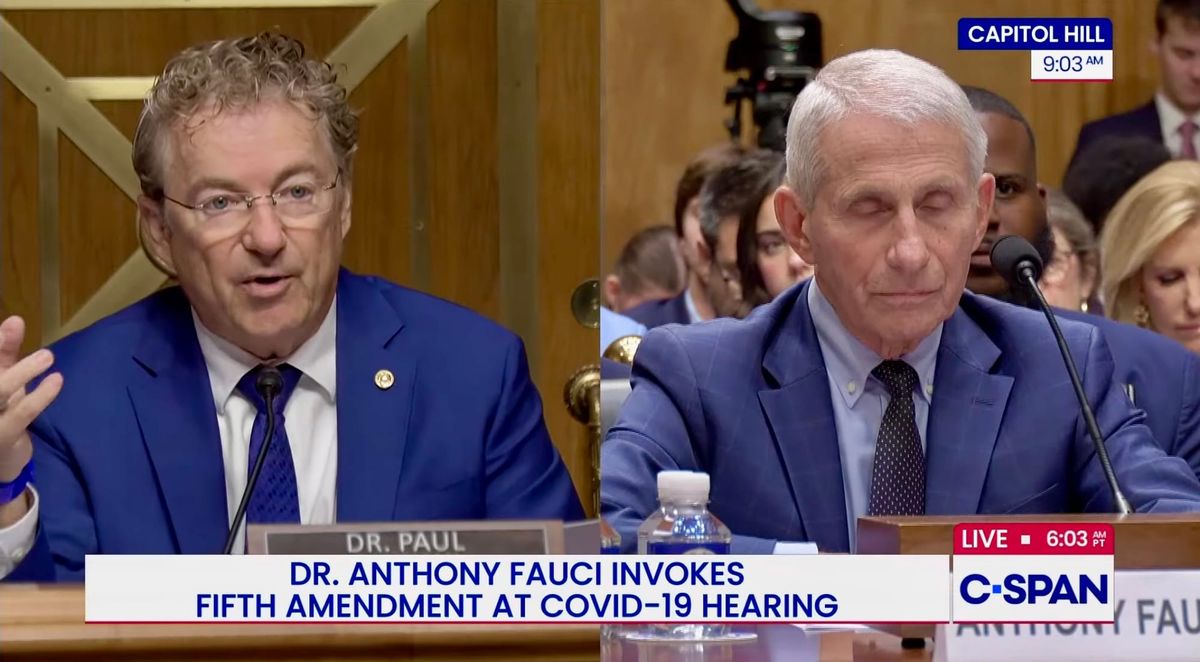
Dr. Anthony Fauci, the longtime federal health official who became the public face of the nation’s COVID-19 response, invoked the Fifth Amendment on Wednesday as he appeared under subpoena before the Senate Homeland Security and Governmental Affairs Committee.
Fauci led the National Institute of Allergy and Infectious Diseases from 1984 through 2022. He also served on President Donald Trump’s White House Coronavirus Task Force and later became President Joe Biden’s Chief Medical Adviser.

Committee Chairman Rand Paul (R-KY) subpoenaed Fauci after years of disputes over the origins of COVID-19, federal grants tied to research in Wuhan, China, and Fauci’s prior statements to Congress. Paul has accused Fauci of misleading lawmakers about whether the National Institutes of Health funded gain-of-function research through the nonprofit EcoHealth Alliance. Fauci has denied that charge and has said the work funded by NIH did not meet the agency’s definition of gain-of-function research.
Paul opened the hearing with a sharp review of Fauci’s record during the pandemic. He accused the former health official of hiding conflicts, pushing damaging lockdown policies, suppressing debate over a possible laboratory origin and failing to preserve key federal records.
Paul argued that Fauci had an interest in steering public discussion toward a natural origin for the virus because a lab accident could have raised questions about U.S.-funded research in China.
He also blamed pandemic restrictions backed by federal health leaders for closed schools, lost jobs, delayed medical care and the collapse of many small businesses.
“The greatest casualty of this pandemic may well be the public’s trust,” Paul said, calling for a full account of how public health leaders made their decisions and communicated them to the nation.
The hearing quickly became a confrontation over what Fauci was willing — or legally required — to say.
Fauci invoked his Fifth Amendment right against self-incrimination more than 100 times and declined to answer nearly every question put to him by Republican Senators. The questions covered the origin of the virus, NIH grants, his communications with other scientists, pandemic policies, entries from his personal diary — and if he could see a folder on the table in front of him.
The Fifth Amendment protects a witness from being forced to give testimony that could be used in a criminal case. Invoking the right is not an admission of guilt.
Fauci said he was following the advice of his lawyers. He accused Paul of conducting what he called an “obsessive vendetta” and attempting to create a trap that could expose him to new criminal charges. Fauci also objected to Paul’s release of his unredacted personal diary, which the Senator has used as part of his inquiry.
Paul rejected that defense and repeatedly pressed Fauci to answer.
The Chairman said the committee would vote next week on whether to hold Fauci in contempt of Congress. Paul argued that Fauci’s broad Presidential pardon may have removed his risk of prosecution for past federal acts and, as a result, weakened his basis for refusing to testify about those acts. Paul acknowledged that the reach of Fauci’s Fifth Amendment rights presents a legal question that may have to be settled in court.
Republicans hold an 8-7 majority on the committee.
Sen. Josh Hawley (R-MO) was among the lawmakers who repeatedly questioned Fauci, at times asking basic or harmless questions in an effort to test the scope of his refusal. Fauci still relied on the Fifth Amendment.
Sen. James Lankford (R-OK) noted during the hearing that Fauci had a constitutional right to invoke the protection, even as other Republicans argued that he was obstructing legitimate congressional oversight.
Democrats defended Fauci and denounced the hearing as a partisan attempt to blame one official for a worldwide pandemic. Sen. Richard Blumenthal (D-CN) compared the inquiry to political persecution, while other Democrats warned that threats of prosecution could discourage doctors and scientists from accepting future government posts.
Paul and other Republicans focused much of their questioning on Fauci’s statements about research conducted at the Wuhan Institute of Virology.
The NIH awarded grants to EcoHealth Alliance, which worked with researchers at the Wuhan laboratory on bat coronaviruses. Paul argues that experiments conducted under those grants made viruses more dangerous and should be viewed as gain-of-function research.
Fauci and his defenders have maintained that the NIH-funded work did not create the virus that caused COVID-19 and did not fall under the federal definition that governed restricted gain-of-function research at the time.
The exact origin of the pandemic remains unresolved. U.S. intelligence agencies have reached different conclusions, often with low confidence. Some favor a laboratory-related incident, while others consider a natural jump from animals to humans more likely. No public evidence has proved that NIH-funded research created SARS-CoV-2, but the two-year investigation by the House Select Subcommittee on the Coronavirus Pandemic found that a “lab-related incident involving gain-of-function research is most likely the origin of COVID-19.” This investigation also determined that ““The Proximal Origin of SARS-CoV-2” publication — which was used repeatedly by public health officials and the media to discredit the lab leak theory — was prompted by Dr. Fauci to push the preferred narrative that COVID-19 originated in nature.”
The legal dispute surrounding Fauci’s testimony is further clouded by a sweeping pardon Biden issued during his final hours in office on Jan. 20, 2025.
The pardon covered any federal offenses Fauci “may have committed or taken part in” from Jan. 1, 2014, through the date of the pardon, as long as those offenses arose from his work as NIAID director, a member of the coronavirus task force, a member of Biden’s COVID-19 response team or Biden’s chief medical adviser.
Biden said at the time that the pardon should not be viewed as an admission that Fauci committed a crime. The former President said it was meant to shield public servants from what he saw as politically driven investigations and possible retaliation.
Still, the unusual preemptive pardon raised questions about why such broad protection was thought necessary when Fauci had not been charged with a crime.
Republicans have also questioned whether Biden personally approved the pardon or whether it was processed with an autopen by White House staff. Paul renewed a criminal referral involving Fauci in 2025, citing what he said was a lack of clear proof of Biden’s direct authorization. Biden has maintained that he made his own clemency decisions.
Use of an autopen does not, by itself, make a Presidential action invalid. The larger dispute is whether Biden knowingly authorized the pardon and its terms.
Trump had previously questioned the validity of several Biden-era pardons tied to the use of the autopen. On Wednesday, however, he appeared to reverse course regarding Fauci’s pardon.
“The most powerful thing a President has, they say, is the power of pardon,” Trump told reporters. “So he was pardoned by Biden, and I respect that. I know how powerful it is.”
Trump’s statement suggests that his administration would honor the pardon as it applies to covered federal conduct through Jan. 20, 2025.
The pardon would not protect Fauci from prosecution for acts committed after it was issued, or outside of the specific time frame described in the pardon. It also cannot block prosecution under State law, though any State case would require a separate legal basis and evidence of a State offense.
Paul warned that the pardon may not shield Fauci from charges linked to Wednesday’s hearing. He said new conduct — such as obstruction of Congress, contempt or false statements made after the pardon — would fall outside its time limits.
Whether Fauci can be prosecuted for refusing to answer remains uncertain. A court would first have to examine the scope of the pardon, whether Fauci retained a reasonable fear of prosecution and whether the committee could lawfully compel answers to each question.
The issue could grow more complex because Fauci’s pardon covered only federal offenses within a fixed period. His lawyers may argue that his testimony could expose him to State charges, crimes outside the pardon’s terms or disputes over whether particular conduct was connected to his official service.
Paul nevertheless ended the hearing by promising further action.
The committee’s planned contempt vote could lead to a criminal referral to the Justice Department, a civil case seeking a court order compelling testimony or another form of congressional enforcement. Paul did not immediately state which path he would pursue.
For now, the hearing produced few new answers about the pandemic’s origins or the federal government’s conduct. Instead, it opened a new legal fight over the reach of Biden’s pardon, Fauci’s Fifth Amendment rights and Congress’ power to force testimony from one of the most divisive public officials of the COVID era.
Senator Paul’s opening remarks may be seen on YouTube and below:
The full Senate Hearing may be seen on YouTube and below: