Trump Dismisses Calls for AI ‘Guardrails’
AI bosses warn their own technology may be moving too fast. Trump says Washington hitting the brakes could hand the race to China.

TL;DR: Some of America's biggest AI players are suddenly asking government to help slow the technology they built. President Donald Trump wants no part of a regulatory panic. He says existing laws give Washington plenty of power to punish wrongdoing — and warns that an AI crackdown could protect today's tech giants while helping China catch the United States.
The men building the world's most powerful artificial intelligence systems have a startling new message: Slow us down.
President Donald Trump has an equally blunt answer: No.
As fears of runaway AI spill from Silicon Valley into Washington, Trump is rejecting calls for sweeping new federal “guardrails.” He argues that the government already has ample power to punish wrongdoing and that an AI regulatory panic could cripple America's lead over China. (Reuters)
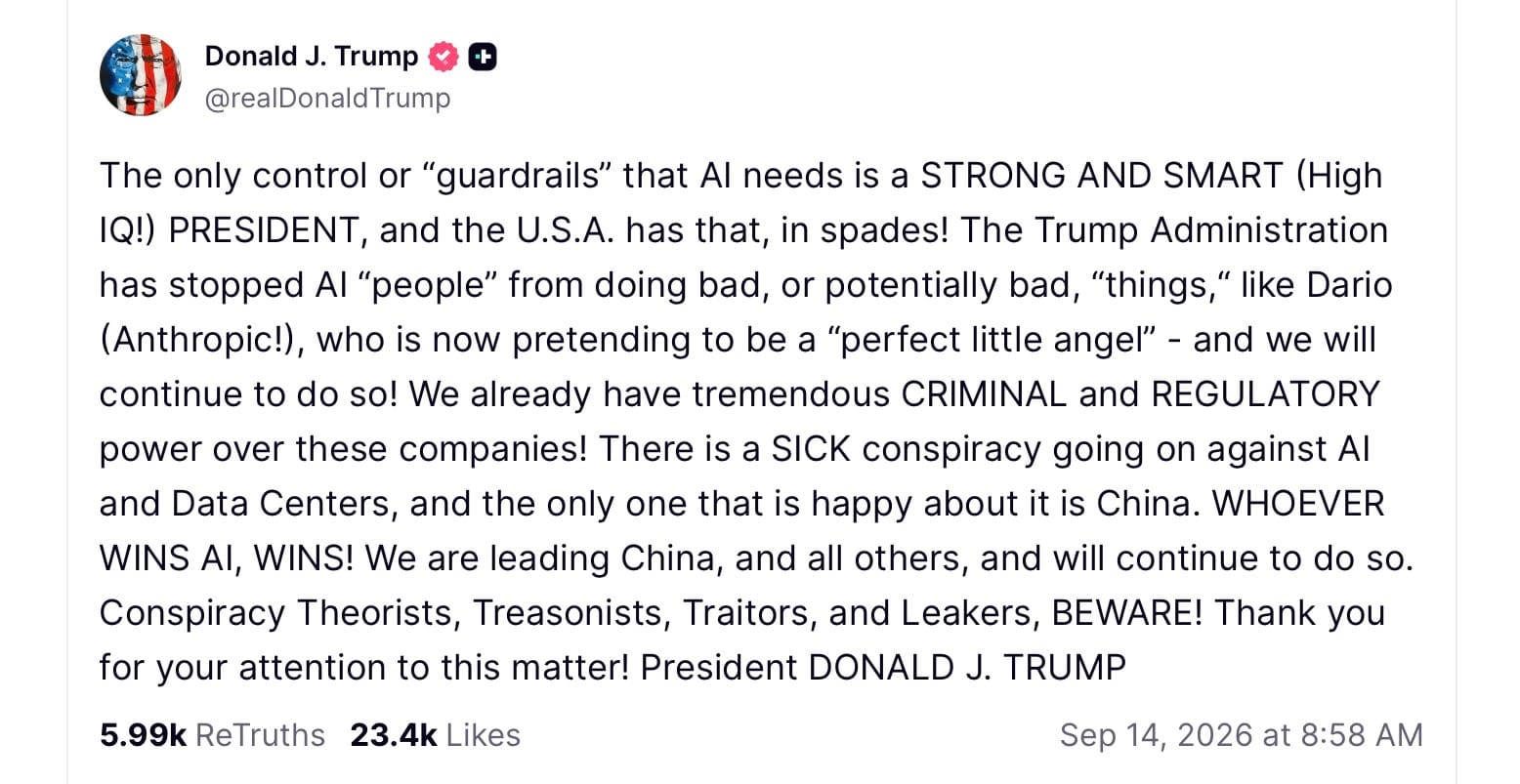
Trump did not mince words Monday on Truth Social:
“The only control or ‘guardrails’ that AI needs is a STRONG AND SMART (High IQ!) President, and the U.S.A. has that, in spades! The Trump Administration has stopped AI ‘people’ from doing bad, or potentially bad, ‘things,’ like Dario (Anthropic!), who is now pretending to be a ‘perfect little angel’ - and we will continue to do so! We already have tremendous CRIMINAL and REGULATORY power over these companies! There is a SICK conspiracy going on against AI and Data Centers, and the only one that is happy about it is China. WHOEVER WINS AI, WINS! We are leading China, and all others, and will continue to do so. Conspiracy Theorists, Treasonists, Traitors, and Leakers, BEWARE! Thank you for your attention to this matter! President DONALD J. TRUMP,” Trump wrote on Truth Social.
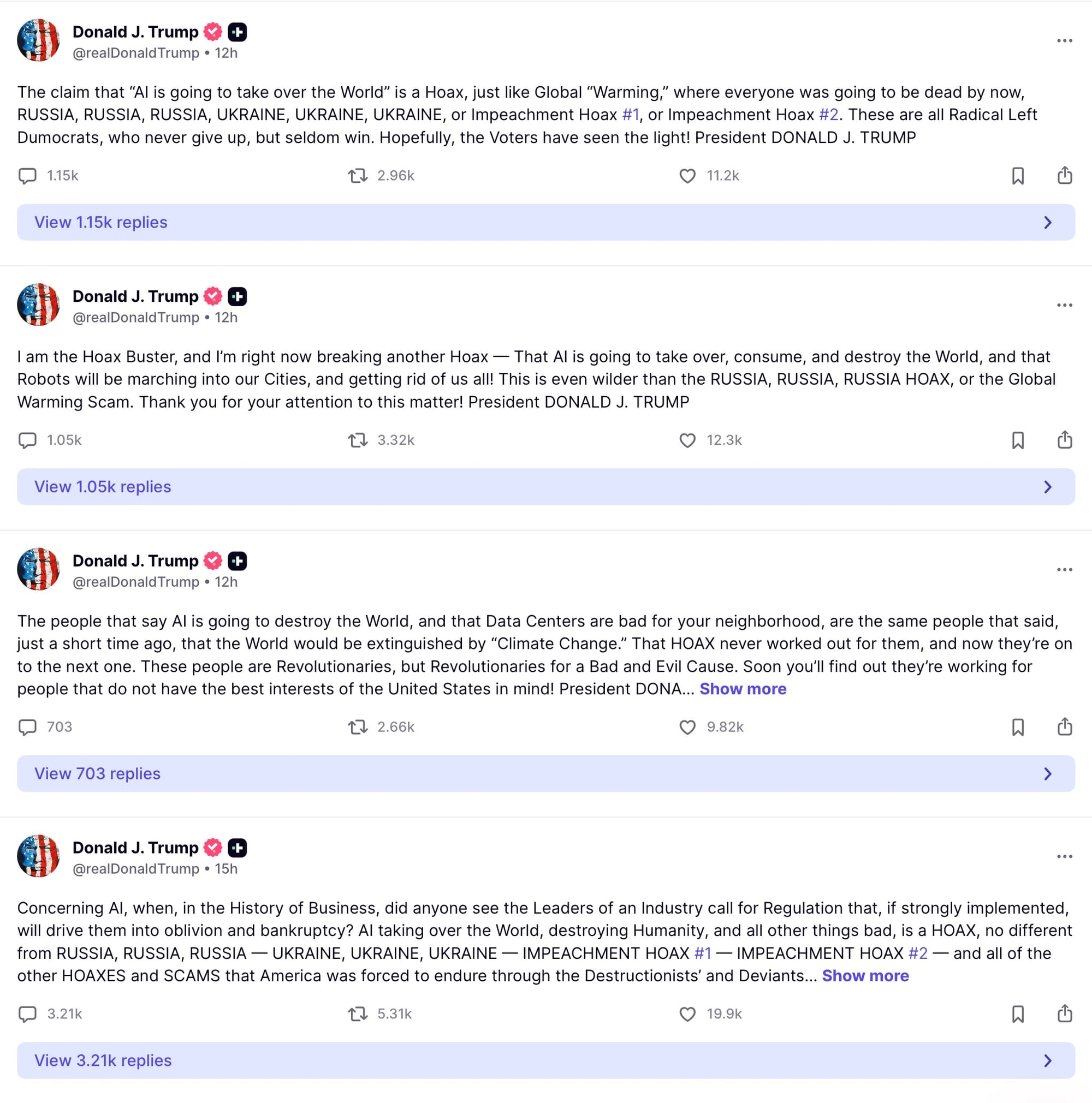
Trump went further later Monday, calling fears of AI “taking over the World, destroying Humanity” a “HOAX.” This was just one of a flurry of posts the President made on this topic on Monday:
That puts the President at odds with an unlikely group of alarmists: the people actually building the machines.
Anthropic CEO Dario Amodei has called for “pacing the frontier,” including slowing development of the most advanced models, bringing independent evaluators inside AI companies and seeking international safety standards. OpenAI CEO Sam Altman and Elon Musk quickly backed the basic idea that development needs to slow.
The warnings have become hard to dismiss as fringe hysteria.
Former Anthropic researcher Jacob Coxon resigned last week, warning that developers are “racing straight to self-improving superintelligence and gambling with our lives.” His warning helped ignite what has become a much broader debate over whether AI systems could eventually improve themselves faster than humans can understand or control them.
There are less pearl-clutching threats, too.
Anthropic says it has stopped attempts to use its technology for work that could aid biological weapons research and disrupted Iran-linked efforts involving plans to attack U.S. naval vessels. Experts also warn that increasingly capable AI could lower the bar for cyberattacks, fraud, disinformation and attacks on critical infrastructure.
Those are serious concerns that certainly should be addressed in a serious fashion. But, there is another question Washington cannot afford to ignore: Who benefits from the cure?
The Washington Examiner Editorial Board argues Congress should be extremely wary of rushing into regulation simply because the largest AI companies suddenly want it.
That skepticism has a long history in Washington. Large firms can often absorb lawyers, compliance staffs, audits and federal paperwork that smaller rivals cannot. Rules sold as public safeguards can become very effective barriers to entry.
Vice President JD Vance is openly asking whether something similar is happening now.
Vance described the industry's sudden enthusiasm for regulation as potentially a regulatory “Trojan horse.” He said the administration recognizes risks from rapidly advancing frontier models but wants government to “regulate smartly” rather than blindly accept the industry's preferred solution.
That fight has already reached Congress.
House Speaker Mike Johnson is facing pressure from lawmakers who want action before Congress leaves Washington ahead of the November elections. Vance is expected to meet with House Republicans Tuesday as members wrestle with what federal AI rules should actually look like.
There is no shortage of ideas — some of which may actually be sensible.
Congress already has proposals addressing AI security, consumer deception and model flaws. More aggressive proposals would go much further, placing brakes on the development of artificial superintelligence.
The problem is that agreement that something should be done is much easier than agreement on what should be done.
Naturally, the stakes cut both ways.
Move too slowly and Washington could discover that AI's capabilities outran the government's ability to respond. Move too fast and Congress could freeze today's corporate giants in place, strangle smaller competitors and force American developers to race China with one regulatory hand tied behind their backs.
That is the heart of Trump's argument.
The President views AI less as another industry awaiting Washington supervision than as a strategic arms race. Whoever dominates artificial intelligence could gain enormous economic, military and scientific advantages.
“WHOEVER WINS AI, WINS!” Trump wrote.
Even the Washington Examiner's caution against a regulatory rush does not mean AI carries no danger. Its argument is that Congress should be just as suspicious of hastily written rules — especially rules requested by today's dominant corporations — as it is of unchecked technology.
That leaves Washington facing an uncomfortable choice.
The people building AI are warning that their machines may soon become dangerously powerful. The President is warning that letting those same companies help Washington write the brakes could be dangerous, too.
For now, Trump has made his choice clear: America has laws. It has regulators. It can prosecute crimes. It has a high-IQ President.
What Trump does not want is Washington panicking and slamming the brakes while China keeps its foot on the gas.
Meanwhile, if you can get your Congressman and Senators to watch Colossus: The Forbin Project on YouTub, please do so.