Trump Up +2 in Alabama as Overall U.S. Ratings Sink
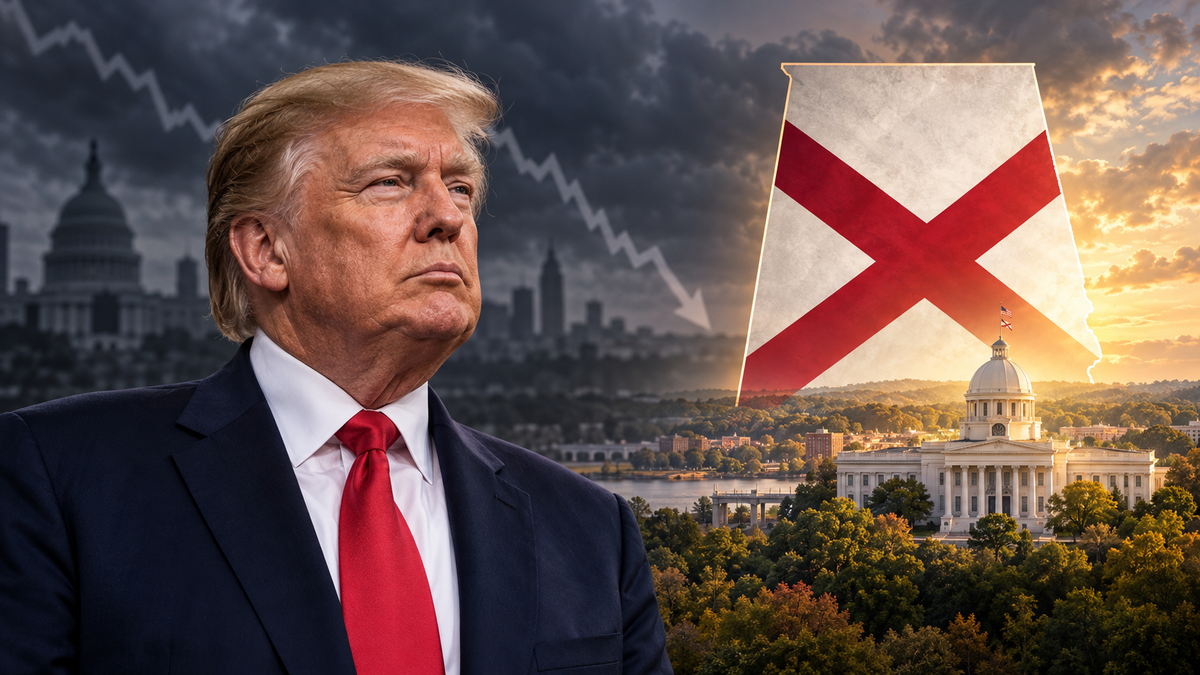
Trump holds a narrow approval edge in Alabama as national ratings slide. However, most voters say polls do not affect their vote
Trump holds a narrow approval edge in Alabama as national ratings slide. However, most voters say polls do not affect their vote
TL;DR: Alabama is one of 10 States where Trump has positive net job approval in Civiqs’ Oct. 8 figures. National polls show broad discontent, but most voters say polls do not shape their choice.
Alabama remains one of the few States where more voters approve of President Donald Trump than disapprove, even as his national ratings sink.
Civiqs tracking through Oct. 8 puts Trump at 46% approval and 44% disapproval among Alabama registered voters. That leaves him two percentage points above water.
The margin is slim. Fewer than half of Alabama voters approve of his work, but those who approve still outnumber those who disapprove.
A count of the tracker’s displayed State figures shows positive net approval in just 10 States. Alabama joins Arkansas, Idaho, Kansas, North Dakota, Oklahoma, South Dakota, Utah, West Virginia and Wyoming. Montana is tied at 46% on each side. Trump is underwater in the other 39 States.
Wyoming gives him his strongest margin, at plus 14 points. Nationally, Civiqs puts him at 33% approval and 60% disapproval, a net rating of minus 27 points.
Trump is most underwater in the these 10 States, ranging from Oregon at −39 points to Hawaii at −61 points: Oregon, Rhode Island, New York, Washington, Connecticut, California, Massachusetts, Vermont, Maryland and Hawaii.
A separate Pew Research Center survey released Oct. 8 paints an even darker picture. Just 30% of U.S. adults approve of Trump’s job performance, while 68% disapprove. His approval is down four points since July and is the lowest of his second term in Pew’s polling.
The strain reaches into the President’s own coalition. Among confirmed 2024 Trump voters, only 67% approve of his work today, down from 95% at the start of his term.
Pew also found a turnout warning for Republicans. Among voters backing Democratic House candidates, 63% said they were extremely motivated to vote. That compares with 46% of those backing Republicans. Democrats led the national House preference question, 44% to 36%.
The survey covered 5,062 adults, including 3,917 registered voters, from Sept. 28 through Oct. 4.
Household costs help explain the sour mood. In Pew’s report on the economy, just 21% rated national conditions excellent or good, down from 28% at the start of the year.
Nearly three-fourths were very concerned about food and consumer goods prices. Healthcare and housing costs also drew broad concern. And 65% said Trump’s economic policies had made conditions worse, while 19% said they had made things better.
Republicans were less upbeat, too. Only 36% rated the economy excellent or good, down from 41% in July.
The Iran conflict adds another burden. Pew’s latest findings on Iran show 65% disapprove of Trump’s handling of the military action, while 33% approve. Republican approval fell from 69% in March to 63%.
Few expect a quick end. Seventy-seven percent expect the conflict to last another six months or more. Higher fuel prices and the risk of American troops being wounded or killed rank among the public’s chief concerns.
Rasmussen Reports’ Oct. 9 tracking poll gives Trump a higher national approval figure: 41% among likely voters. But 58% disapprove, leaving him 17 points underwater.
These surveys cover different groups: adults, registered voters and likely voters. Their figures should not be treated as a single measure. Still, all three show national disapproval outpacing approval.
Alabama’s narrow positive margin stands apart. It also leaves little room for Trump’s standing to slip before the State joins the negative column.
But polls do not cast ballots, and most voters say polling news does not guide their choice. A separate Rasmussen survey found 76% of likely voters said polls do not affect how they vote. Only 19% said they do.
That survey of 1,085 likely voters was conducted Sept. 29 through Oct. 1, with a margin of error of three points. The numbers may frame the race. Most voters say they will make their own call.
And for now, Trump continues to be above water in Alabama.