Voted No, Cashed In — The Paper Trail Behind Beau's Law
In Alabama politics, money has always talked. With Beau's Law, it left a paper trail—Guest Opinion by Gail Mallard
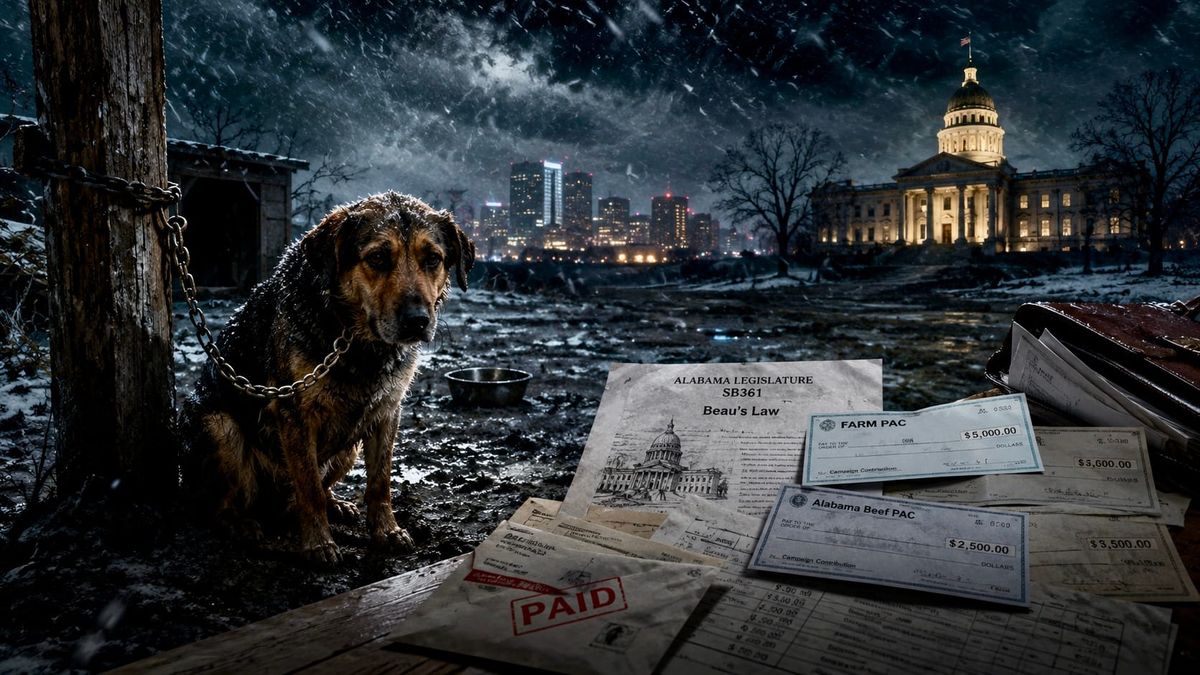
Guest Opinion by Gail Mallard
In Alabama politics, money has always talked. With Beau's Law, it left a paper trail.
SB361, known as Beau's Law, passed the Alabama House on April 9, 2026, and was signed into law the same day. By fall, it takes effect. It was a win, but not the kind that comes without a cost. A bloc of state representatives voted against it, and when you cross-reference those no votes against campaign finance records filed with the Alabama Secretary of State, a pattern emerges that every Alabama voter deserves to see.
The two organizations that fought hardest against Beau's Law were Alfa's FARM PAC and the Alabama Cattlemen's Association's Alabama Beef PAC. Both were publicly opposed to the bill. Both were actively writing checks to Alabama legislators throughout the same legislative session. And the representatives who received those checks voted overwhelmingly against the bill those PACs opposed.
That is not a coincidence. That is a system.
Before the Vote: The Investment
The money started moving long before April 9. These are not allegations. These are disclosures pulled directly from the Alabama Secretary of State's FCPA Electronic Reporting System, a public database that candidates are required by law to update.
Rep. Brock Colvin received $5,000 from FARM PAC on September 18, 2025. Rep, Jim Carns took $5,000 from FARM PAC on November 8, 2025. Rep. Mark Gidley collected $5,000 from FARM PAC across two donations in November and December 2025. Rep. Chip Brown received $3,000 combined from FARM PAC and Alabama Beef PAC in October and December 2025. Rep. Ron Bolton took $3,000 across donations in May and November 2025. Rep. Arnold Mooney received $2,500 from FARM PAC on June 30, 2025. Rep. Jennifer Fidler collected $3,000 between the two PACs before the vote. Rep. Kenneth Paschal, Bill Lamb, Donna Givens, Curtis Travis, Berry Forte, Steve Clouse, and Marcus Paramore each received $2,500 from FARM PAC in the months leading up to April 9. Rep. Kristin Nelson and Matthew Hammett each received $500 from Alabama Beef PAC before the vote. Senator Will Barfoot received $1,500 from Alabama Beef PAC on May 11, 2025.
Every one of them voted no.

After the Vote: The Thank-You Checks
Then the bill passed anyway. And the checks kept coming.
This is where it stops looking like influence and starts looking like payment for services rendered.
Rep. Jim Carns received $6,500 from FARM PAC on May 7, 2026, nearly four weeks after the vote and weeks after the bill was already signed into law. $6,500. After the fact. From the PAC that opposed the bill he voted against. Rep. Carns also received $6,241.90 of in-kind contributions on May 11, 2026, and another $6,241.90 of in-kind contributions on May 23, 2026. Rep. Ivan Smith, who had already collected $5,000 from FARM PAC in November 2025, received an additional $500 from Alabama Beef PAC on May 6, 2026, nearly a month after the bill passed. Rep. David Standridge received $500 from Alabama Beef PAC on May 6, 2026. Rep. Mike Kirkland received $500 from Alabama Beef PAC on May 7, 2026. Rep. Jennifer Fidler, who had already taken pre-vote money, received an additional $500 from Alabama Beef PAC on May 6, 2026.
The vote was April 9. The law was signed April 9. These PACs spent the following weeks cutting checks to the legislators who voted their way.
If the pre-vote money looks like an investment, the post-vote money looks like a thank-you note written with a comma and three zeros.
The Full Picture
Two representatives on the no-vote list, Rep. Thomas Jackson and Rep. Chad Robertson, show no contributions from these groups in the available records. That matters and it should be said plainly. Not everyone who opposed this bill was on the PAC payroll. But the fact that most were is not something that can be explained away.
Two other no votes, Rep. Jim Hill and Rep. Brett Easterbrook, are not seeking reelection. Neither has filed a recent campaign finance report with the Secretary of State.
What the records do show, taken together, is this: the PACs that publicly fought Beau's Law funded the legislators who voted against it, before the vote and after it. The amounts varied. The pattern did not.
Alabama's campaign finance system exists precisely so voters can see these connections. Most people never look. The organizations that write these checks are counting on that. They have built an entire influence operation on the assumption that Alabamians are too busy, too tired, or too cynical to follow the money.
Follow the money.
Every donation listed here is a public record. Every date is verifiable. Every legislator named had the opportunity to vote for Beau's Law and chose not to. What their constituents do with that information now is the only question that remains.
Beau's Law will protect Alabama's animals beginning October 1, 2026. It passed without the help of these legislators. Come election day, voters have the chance to decide whether these representatives deserve to keep the jobs they've been doing so well for the PACs that fund them.
Who does your representative work for?
The receipts suggest they already answered that question. They just never answered it to you.
Gail Mallard is the nom de guerre of a concerned Alabama Republican. ALPolitics.com has chosen to respect the use of this pseudonym as a reflection of the writer’s Constitutional and unalienable rights.
Opinions do not reflect the views and opinions of ALPolitics.com. ALPolitics.com makes no claims nor assumes any responsibility for the information and opinions expressed above.
Editor’s note: Beau’s Law, passed during the 2026 legislative session, establishes Alabama’s first statewide standards in more than two decades for the care of dogs kept outdoors. The law requires owners to provide adequate food, clean water, shelter, and humane tethering conditions, while banning the use of logging chains, choke collars, and unsafe restraints. Named after a Birmingham dog found chained outside during a winter storm, the legislation also creates escalating criminal penalties for repeat violations and is set to take effect Oct. 1, 2026.