
‘Wolves in White Coats’ Targets Youth Gender Medicine
A new HHS report alleges profit, ideology and suspect billing drove the rapid growth of gender treatments for American children
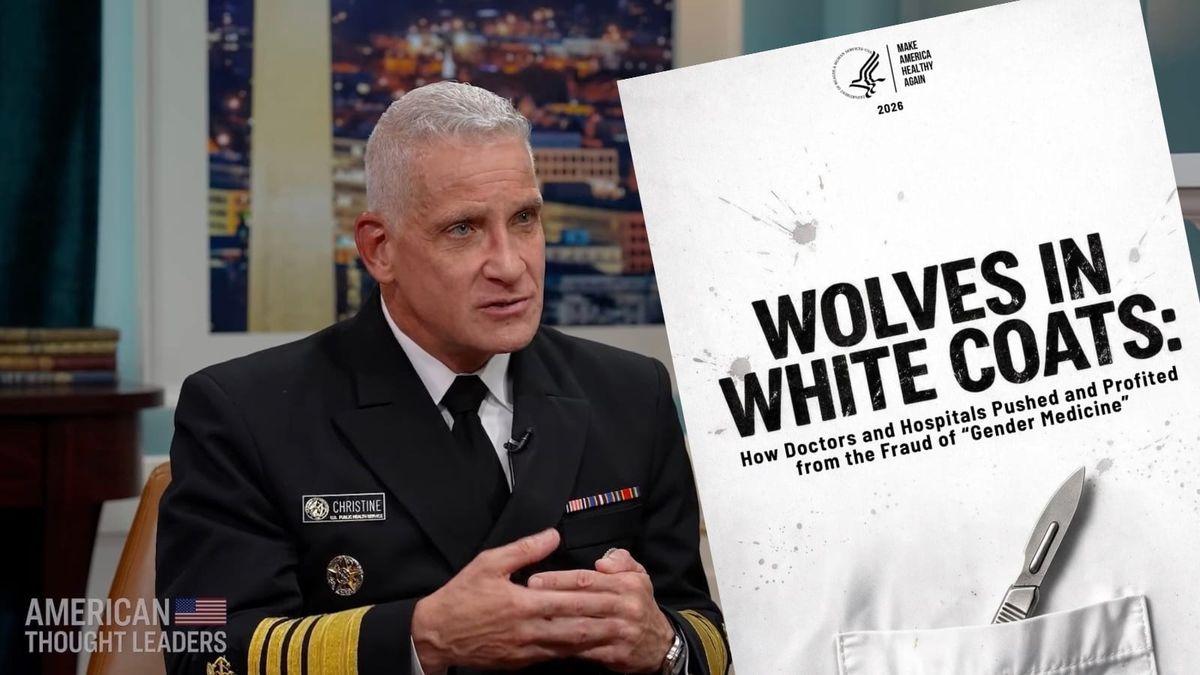
TL;DR: A new HHS report, Wolves in White Coats, alleges that profit, ideology and suspect insurance billing fueled the rapid growth of puberty blockers, cross-sex hormones and surgeries for minors. HHS Assistant Secretary Dr. Brian Christine says some clinics created “captive patients” who require lifelong care. The report comes amid a wider retreat from such treatments, including new caution from major medical groups, limits in Europe, the Supreme Court’s decision upholding Tennessee’s ban and the end of challenges to Alabama’s youth-transition law. Its fraud claims remain under investigation.
A new federal report accuses hospitals, doctors and medical groups of turning children with gender distress into lifelong patients while using suspect billing codes to obtain insurance payments.
The 64-page report, “Wolves in White Coats: How Doctors and Hospitals Pushed and Profited from the Fraud of ‘Gender Medicine,’” was commissioned by the U.S. Department of Health and Human Services.
It examines the sharp rise in the use of puberty blockers, cross-sex hormones and gender-transition surgery on minors. It also alleges that profit, ideology, federal pressure and weak oversight helped drive that growth.
Admiral Brian Christine, M.D., the Assistant Secretary for Health at HHS, discussed the findings in a lengthy interview with American Thought Leaders.
Christine, an Alabama urologist who leads the U.S. Public Health Service Commissioned Corps, said gender dysphoria is a real mental-health condition. He argued, however, that drugs and surgery do not change a child’s biological sex and can cause permanent harm.
“If you take a child who has gender dysphoria and you get them to agree to sex-rejecting procedures, the cross-sex hormones or the puberty blockers or certainly the surgeries, then what you’ve done, you’ve created a patient for life, is what we like to say,” Christine said.
The phrase “sex-rejecting procedures” is used by HHS to describe treatments more often called “gender-affirming care” by supporters. Christine described puberty blockers as potentially “castrating” drugs and called some surgeries “mutilating.”
Those comments reflect a profound change in federal policy. The Biden administration treated puberty blockers, cross-sex hormones and surgery as accepted medical care for some minors. The Trump administration now disputes that premise and is cutting federal support for the procedures.
The HHS report arrives as medical groups, courts, state governments and health agencies in Europe move toward a more cautious approach.
What was often presented just a few years ago as settled science is no longer settled at all.
The report says more than 225 hospitals and health systems had established pediatric gender programs by the early 2020s.
Traditional child care often involves short-term treatment. A child sees a doctor for an infection, an injury or a routine checkup and then goes home.
A child placed on the medical-transition path may require repeated visits, lab work, prescriptions, mental-health services, fertility counseling, surgery and care for complications. Some treatment may continue for decades.
“What we point out in the report is that there was a tremendous financial incentive for these clinics and these practitioners to produce what we call captive patients,” Christine said.
He explained that puberty blockers and hormones require repeat prescriptions, blood tests and office visits.
“So there can be a tremendous financial incentive for these practitioners and these clinics to have these patients who come back again and again and again and bill again and again and again,” Christine said.
The report cites an analysis estimating almost $120 million in charges for gender-related procedures involving minors beginning in 2019. That figure included 5,747 minors who reportedly underwent surgery and 8,579 who received hormones or puberty blockers.
Those figures came from the Stop the Harm database rather than from HHS claims data alone. They represent billed charges, not proof of profit or the amount insurers ultimately paid.
The report estimates that yearly insurance costs may range from $545 for androgens and $735 for estrogen to $16,385 for some puberty-blocking drugs. It says lifetime drug and treatment costs can reach $25,000 to $75,000 before surgery.
The surgical costs can be far higher. The report places the average insurer cost of a double mastectomy at $12,680. It lists an average cost of $53,645 for vaginoplasty and $133,911 for phalloplasty, not counting related procedures, care for complications or out-of-pocket bills.
HHS argues that those costs gave hospitals a financial motive to expand pediatric gender clinics even as doubts grew about the quality of the medical evidence.
The most serious allegations involve the diagnostic codes used to secure payment.
Doctors use International Classification of Diseases codes to tell insurers why a treatment was provided. They use separate procedure codes to show what was done. Insurers then decide whether the treatment was needed and should be covered.
According to the HHS announcement, the department examined nationwide public and private insurance claims from 2015 through 2025.
It identified about $50 million in claims for puberty blockers prescribed to patients ages 9 through 17 under codes for endocrine disorders. Those claims excluded the code for precocious puberty, the disorder for which puberty blockers were first developed.
HHS also found nearly $11 million in puberty-blocker claims for patients ages 13 through 17 who were coded as having precocious puberty.
Precocious puberty means puberty that begins far earlier than normal. HHS argues that a teenager cannot meet the standard definition of that diagnosis.
Christine said the coding did not always match the child’s true condition.
“What we see in this report is that again and again, codes were assigned for billing purposes that did not accurately describe what was going on with these children,” he said. “Coding that did not accurately describe what was being done.”
The billing patterns are not, by themselves, proof that each provider committed fraud. HHS described them as potentially improper and said they warrant a formal probe.
Vice President JD Vance referred providers identified in the report to the Justice Department. HHS Secretary Robert F. Kennedy Jr. sent a separate referral to the department’s Office of Inspector General for review of possible violations of federal law.
“Doctors and hospitals must put children’s health ahead of ideology and financial gain,” Kennedy said. “This report identifies troubling billing practices that demand scrutiny.”
The HHS report did not emerge in a vacuum. It is just the latest step in a slow, definite shift away from the aggressive medical treatment of children with gender distress.
As ALPolitics.com reported, the American Society of Plastic Surgeons issued a position statement in February advising its members to delay gender-related chest, genital and facial surgery until patients are at least 19.
“There is currently insufficient evidence showing a favorable risk-benefit ratio for gender-related surgeries in children and adolescents,” the group said.
The society represents more than 11,000 plastic surgeons. Its guidance is not binding and does not endorse criminal penalties. It is still a sharp break from the broad medical claims made during the early 2020s.
The American Medical Association quickly said it agreed that such surgery on minors should “generally be deferred to adulthood.” The AMA has not rejected puberty blockers or cross-sex hormones for minors, making its change narrower than the HHS position.
Even so, the move is hard to dismiss. Two major medical groups now concede that long-term evidence does not support firm claims that the benefits of gender-related surgery outweigh the risks for children.
The plastic surgeons’ statement cited the Cass Review, a major review commissioned by England’s National Health Service. Dr. Hilary Cass found that the evidence supporting puberty blockers and cross-sex hormones for minors was weak.
Finland, Sweden and the United Kingdom have since moved toward tighter limits, more mental-health care and greater use of controlled research.
The NHS has also moved toward a broader assessment model for children referred for gender distress. As discussed in an ALPolitics.com opinion column, “No, Toddlers Aren’t Trans,” the approach calls for more family involvement and psychosocial care rather than placing children on a rapid track toward drugs and surgery.
Cass recommended that puberty blockers be limited to tightly controlled research. She called for more therapy and a fuller review of a child’s mental health, family life, development and other factors that could be causing distress.
That is close to the approach Christine now advocates at HHS: compassionate counseling without rushing a child into choices that cannot be undone.
Alabama was years ahead of the federal change.
The Legislature approved the Vulnerable Child Compassion and Protection Act in 2022. The law makes it a felony for a medical provider to prescribe puberty blockers or cross-sex hormones to anyone under 19 for the purpose of attempting to alter or affirm a sex identity that conflicts with the child’s biological sex.
It also bans gender-transition surgery on minors while allowing treatment for certain disorders of sexual development and other medical conditions.
The American Civil Liberties Union, Southern Poverty Law Center and several families challenged the law. A federal district judge blocked parts of it, but the 11th U.S. Circuit Court of Appeals later allowed the ban to take effect.
As ALPolitics.com reported, the plaintiffs voluntarily withdrew their case in May 2025.
“We uncovered the truth. We exposed the scandal. We won,” Alabama Attorney General Steve Marshall said at the time. “Alabama led the way, and now all families are safer for it.”
Marshall said evidence obtained during the case showed that some medical standards were shaped by activists and lawyers rather than strong clinical data.
“What we found was devastating to the plaintiffs’ challenge: a medical, legal, and political scandal that will be studied for decades,” Marshall said. “Given the evidence we uncovered, it is no surprise the plaintiffs abandoned their challenge.”
A month later, the U.S. Supreme Court gave States even more room to restrict such procedures.
In United States v. Skrmetti, the justices upheld Tennessee’s ban on puberty blockers and hormones for minors in a 6–3 ruling.
Chief Justice John Roberts wrote that the law survived rational-basis review under the Equal Protection Clause. He stressed that the Court was not deciding whether Tennessee had chosen the best policy.
“Our role is not ‘to judge the wisdom, fairness, or logic’ of the law before us, but only to ensure that it does not violate the equal protection guarantee of the Fourteenth Amendment,” Roberts wrote.
The ruling placed decisions about youth gender medicine largely in the hands of voters and state lawmakers. It also weakened the legal grounds for challenges to laws such as Alabama’s.
The Court’s three liberal justices dissented. Justice Sonia Sotomayor said the majority had abandoned transgender children “to political whims.” Medical and civil-rights groups continue to argue that bans interfere with the judgment of doctors and parents and may harm children who believe they benefit from treatment.
The debate has moved significantly in a very short time.
A few years ago, opponents of puberty blockers, hormones and gender surgery for children were often accused of rejecting medical science. Today, European health systems have pulled back. The nation’s largest plastic-surgery group recommends waiting until adulthood. The AMA now agrees that surgery should generally be delayed. The Supreme Court has upheld State bans. Alabama’s law remains in force.
HHS has gone further by alleging that the rapid growth of the field was driven not merely by bad judgment, but also by ideology, federal pressure and financial gain.
The report includes accounts from former patients and parents who say clinics failed to examine sexual abuse, autism, depression, family conflict and other factors before recommending medical treatment. Several said they later struggled to find help when they suffered complications or chose to detransition.
Among them is Clementine Breen, who was given puberty blockers at 12, testosterone at 13 and a double mastectomy at 14. Breen later detransitioned and sued her former medical providers. Her allegations remain pending in civil court.
Christine said the Trump administration intends to support young people who were harmed and hold accountable any provider found to have broken the law.
“Our responsibility as healthcare professionals, first and foremost, is to do no harm,” Christine said in the HHS release. “As HHS’ commissioned report Wolves in White Coats details, the medical establishment created what the report describes as ‘captive patients,’ placing vulnerable children on a path toward potentially lifelong medical interventions.”
The report’s fraud allegations still must be investigated and proved. Its broader message, however, is already clear.
The age of treating pediatric gender medicine as beyond debate is over.
Dr. Christine’s full interview may be seen on YouTube and below: