
The Doctrine Behind the Infrastructure
The Infrastructure Is the Argument — Part 2 of 6. Guest Opinion by Alicia Haggermaker
Guest Opinion by Alicia Haggermaker
This is Part 2 of a six-part series on Alabama's data center buildout and what it actually enables. Part 1 established what the infrastructure is for beyond the economic development pitch — behavioral modification at population scale, dream incubation advertising, and a $26 billion neuromarketing industry already mapping your brain's responses to stimuli. This part goes further back: none of this was invented recently, and the company that supplied the original program's pharmaceutical backbone just broke ground in Huntsville.
Before continuing — an update on Bessemer specifically that answers the central question of this series more directly than anticipated.
Update: What Bessemer Actually Agreed To
Documentation obtained under threat of litigation by the Southern Environmental Law Center on behalf of the Alabama Rivers Alliance reveals that the City of Bessemer signed a non-disclosure agreement with the developers of Project Marvel — a $14.5 billion, 1,600-acre hyperscale data center — requiring city officials to destroy all copies of information the developer considers confidential at any time the developer requests. That includes notes taken by city officials about the project itself.
Only three city employees including Mayor Kenneth Gulley signed the agreement — yet the entire city is expected to follow its terms. The NDA runs through 2027. It was originally governed by Georgia law before being amended to Alabama law. The city refused to release it for months until litigation was threatened. A Southern Environmental Law Center attorney stated that destroying public records under the NDA's terms would be clearly illegal under Alabama public records law. Council member Cleo King said he was "totally shocked" and confirmed he did not sign it.

The community being asked to host infrastructure that processes its residents' data agreed in writing to erase what it knows about that infrastructure whenever the developer says so.
That is the documented answer to the question this series has been asking: what did the community consent to?
They consented to not knowing. Officially. In writing. Under a legal obligation to destroy the evidence on command.
The thing about the infrastructure being built right now is that it looks new.
New buildings. New technology. New companies with new names and new logos and new press releases about innovation and progress and Alabama's place in the future of the digital economy.
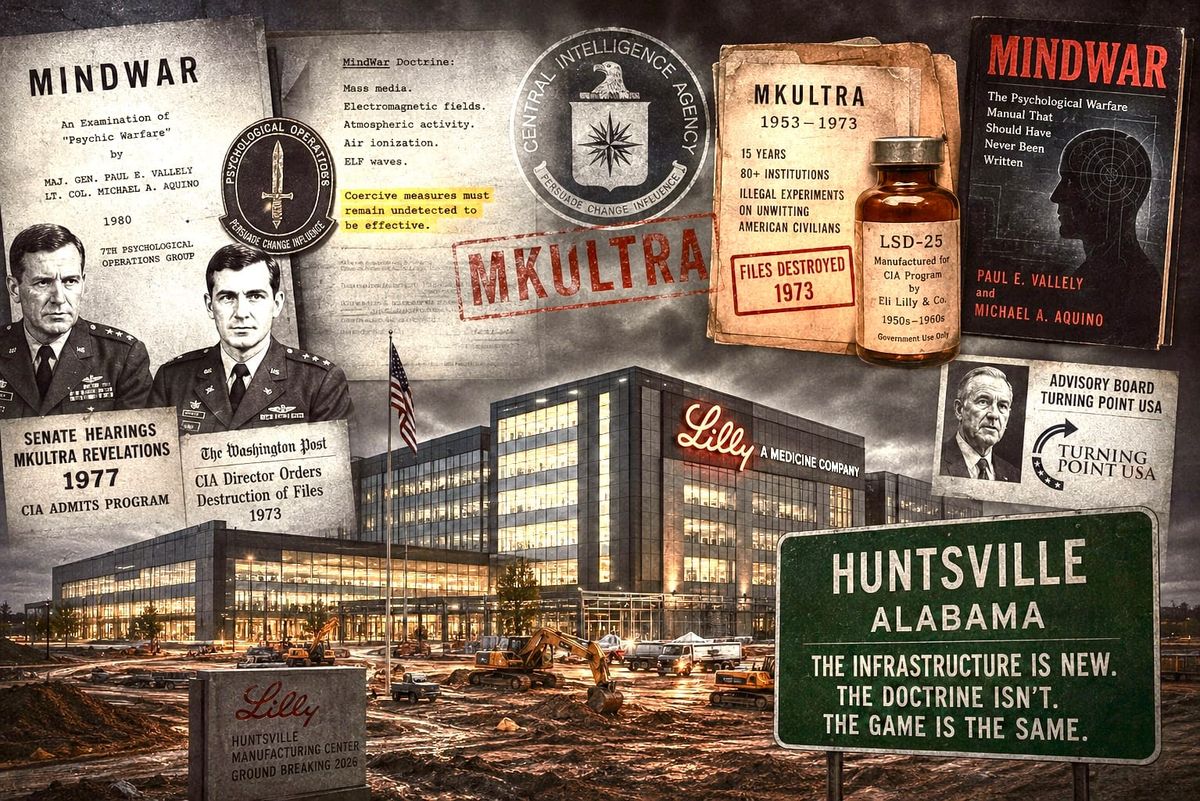
The doctrine underneath it is forty-five years old. The institutional lineage underneath the doctrine is older than that. And the company that manufactured the CIA's mind control drug supply in industrial quantities during a fifteen-year covert program of illegal experiments on unwitting American civilians is breaking ground in Huntsville in 2026.
None of that is hidden. It just hasn't been in the same room at the same time.
The Paper
In 1980, Army Major General Paul Vallely and Lieutenant Colonel Michael Aquino co-authored a paper that circulated quietly through governmental offices, commands, and agencies for years.
They called it MindWar.
Vallely commanded the 7th Psychological Operations Group. Aquino was a psychological warfare specialist who simultaneously served as the founder of the Temple of Set — a Satanic religious organization he established after leaving Anton LaVey's Church of Satan. He held a Top Secret security clearance throughout. That is not incidental context. That is who was writing Pentagon psychological warfare doctrine.
The paper proposed retiring the language of "psychological operations" in favor of something more direct: war waged on the minds of populations. Not enemy populations. Not foreign combatants. Populations. The document explicitly outlined using mass media, electromagnetic field manipulation, atmospheric activity, air ionization, and extremely low frequency waves to make minds more receptive to ideas.
It noted — with the casual confidence of people who expected to get away with it — that coercive measures must remain undetected to be effective.
Read that again. The coercion only works if you don't know it's happening.
Vallely went on to sit on the advisory board of Turning Point USA — Charlie Kirk's youth political organization — before quietly disappearing from their website without public explanation. The MindWar paper does not appear in his TPUSA biography. It does appear in his Wikipedia entry.
The paper was eventually published in book form in 2013, revised in 2016, and is available on Amazon. It describes itself as asking whether government involvement in "invasion of the mind" extends "beyond the blundering, haphazard legacy of the infamous MKUltra experiments" to "dark and arcane arts."
Aquino wrote that. It's on his website. Nothing about this is hidden.
The Program That Came Before
MindWar did not emerge from a vacuum. It emerged from an institutional ecosystem that had spent the previous twenty-seven years doing exactly what the paper described — on American citizens, without their knowledge or consent.
MKUltra launched in 1953. The CIA ran it for fifteen years across more than 80 institutions — 44 colleges and universities, 12 hospitals, pharmaceutical companies, and prisons. The program investigated behavioral modification, drug-induced compliance, hypnosis, sensory deprivation, electroshock, and the systematic demolition of individual psychological identity. Many subjects had no idea they were in a program at all.
In 1973, CIA Director Richard Helms ordered all MKUltra files destroyed. In 1977, a Freedom of Information Act request uncovered 20,000 documents that survived in the wrong filing cabinet. The Senate held hearings. The CIA admitted the program. The public was briefly horrified.
Then the story moved on.
What didn't move on was the institutional logic. Three years after the files were burned, Aquino and Vallely put the doctrine on paper and called it MindWar.
For the full documented history of MKUltra's university network, its pharmaceutical supply chain, and its connections to programs still operating today, see the companion piece at Unprecedented Times. They Weren't Hiding It
The Company
Here is the detail that requires you to stop for a moment.
MKUltra needed product. The CIA's primary research tool was LSD, and they needed it in quantity. In 1954, the CIA contracted a pharmaceutical company called Eli Lilly to solve the problem. Lilly developed a process to manufacture LSD synthetically and at scale. According to declassified documents available through the National Security Archive, Lilly agreed to produce it in what the documents describe as "tonnage quantities." They became the CIA's primary supplier of the drug that sat at the center of a fifteen-year program of illegal experiments on unwitting American civilians.
That company is the same company that later gave the world Prozac. And Zyprexa. And Cymbalta. The same company that became one of the dominant architects of mass-market psychiatric medication for tens of millions of Americans.
And in December 2025, Governor Kay Ivey announced that Eli Lilly and Company would invest more than $6 billion in a new advanced manufacturing facility in Huntsville, Alabama — the largest initial private investment in state history.
The facility will produce small molecule synthetic and peptide medicines using machine learning, AI, digitally integrated monitoring systems, and advanced data analytics. Lilly's own press materials list neuroscience among its core therapeutic areas. Construction begins in 2026. The site was selected partly on the basis of its proximity to the HudsonAlpha Institute for Biotechnology — a private genomics and biotech research campus with deep federal research connections that Lilly's CEO specifically named as a decisive factor.
The company that manufactured the CIA's mind control drug supply in industrial quantities is building its largest American facility ninety minutes from Alabama's new Space Command headquarters, adjacent to a federally-connected genomics research campus, in the same year that the behavioral modification infrastructure this series documents is being proposed for Alabama communities.
Whether that convergence is meaningful is a question worth asking at the Bessemer meeting and at the state legislature and at every county commission considering a data center approval in Alabama.
What DARPA Is Doing Right Now
DARPA — the Defense Advanced Research Projects Agency, the renamed successor to ARPA whose institutional lineage runs directly through the MKUltra era — currently lists the following programs on its own public website:
N3: Next-Generation Nonsurgical Neurotechnology. Goal: develop high-performance, bidirectional brain-machine interfaces for able-bodied service members. Read that carefully: not for injured veterans, not for medical applications, but for healthy soldiers. The interfaces read from the brain and write to it. Without surgery. Current contractors include Johns Hopkins University Applied Physics Laboratory and Carnegie Mellon University.
Narrative Networks. Goal: develop a closed-loop system that adapts a narrative in real time based on a listener's brain signals. In plain language: a system that detects how a story is affecting your brain and adjusts the story accordingly to produce a desired cognitive response.
Targeted Neuroplasticity Training. Goal: use peripheral nerve stimulation to accelerate skill acquisition in military personnel by enhancing the brain's mechanism for forming new memories and connections.
None of this is classified. It is on DARPA.mil. It is not hidden. What is absent is any public conversation about what it means that the agency whose institutional lineage runs through fifteen years of illegal behavioral modification experiments on unwitting American civilians is now openly developing technology to read, write to, and reshape the human brain — and doing so at the same universities.
The Pipeline
DARPA operates with 220 employees and no in-house labs. Its entire model is: seed technology using public funds at universities and research institutions, let the private sector develop it, and then step back as the private sector commercializes it and owns it permanently.
The internet came from ARPA. GPS came from DARPA. Facial recognition came from DARPA-funded research. Behavioral prediction algorithms came from DARPA-funded research. All of it flowed outward from government seed funding into private ownership that you now interact with every day without thinking about where it came from or who designed it for what original purpose.
The dream incubation apparatus, the neural data collection infrastructure, the bidirectional brain-computer interfaces — they are following the exact same pipeline. Seeded with public funds. Developed at universities. Commercialized by private actors. Owned permanently by those actors with no meaningful accountability to the public whose tax dollars funded the foundational research.
The data centers being proposed for Alabama communities are the next node in that pipeline. They are not the beginning of something new. They are the scaling infrastructure for something that has been building for seventy years.
When the Pipeline Went Public
On June 13, 2025, the United States Army held a commissioning ceremony at Joint Base Myer-Henderson Hall in Virginia and swore in four men as Army Reserve Lieutenant Colonels.
They were not career military officers. They had not served in uniform before. They had not completed basic training, officer candidate school, or any of the professional military education requirements the Army has maintained for generations. They had not deployed. They had not spent years in grade demonstrating judgment, leadership, and loyalty to the institution before the institution granted them authority within it.
They were technology executives. And they skipped directly to Lieutenant Colonel — O-5 — bypassing all twenty-two ranks beneath it.
The unit they were commissioned into is called Detachment 201: The Army's Executive Innovation Corps. The four new Lieutenant Colonels are Shyam Sankar, Chief Technology Officer of Palantir; Andrew Bosworth, Chief Technology Officer of Meta; Kevin Weil, Chief Product Officer of OpenAI; and Bob McGrew, former Chief Research Officer of OpenAI and current advisor at Thinking Machines Lab.
The Army's stated purpose is to "fuse cutting-edge tech expertise with military innovation" — working on targeted projects to "guide rapid and scalable tech solutions to complex problems" and make "the force leaner, smarter, and more lethal."
For anyone who has served in the United States military, that rank shortcut requires a moment of acknowledgment. Lieutenant Colonel is the rank you reach after roughly sixteen to twenty-two years of service — years of subordinating yourself to the institution, earning command progressively, passing fitness standards, completing professional military education, deploying, and demonstrating over time that your judgment and loyalty meet the standard the Army holds its officers to. Every person who earned O-5 the conventional way did so through years of sacrifice that civilians don't see and can't fully measure.
These four men did it in a ceremony. According to reporting by Wired, the Army did not conduct an extensive study of the specific talents required for the program and did not run an open competitive selection process. Palantir's Sankar recruited the other three members himself. Defense One reported the Army was not entirely sure what Detachment 201 would actually do.
What it does do is give four private technology executives — simultaneously running the companies that own the infrastructure documented in this series — commissioned rank, security clearance access commensurate with O-5, and standing in the chain of command that a civilian advisor does not have.
The Palantir CTO who is running the company formally partnered with Israeli military intelligence, processing American immigration data, and operating the AI targeting systems documented in Part 3 — now holds a commission in the United States Army.
The Meta CTO who oversees the platform that ran the 2014 emotional contagion experiment on 689,000 unwitting users and has spent two decades building the behavioral response database that trains dream incubation targeting systems — now holds a commission in the United States Army.
The OpenAI executives who run the AI systems processing and generating content across the infrastructure documented in this series — now hold commissions in the United States Army.
The MindWar paper said the coercion only works if you don't know it's happening. Detachment 201 is the moment the civilian technology infrastructure and the military formally merged — not in a classified program, not behind closed doors, but in a press release from the United States Army on a Friday afternoon in June 2025.
They told you. Most people just weren't paying attention.
What It Does to Your Body
One more thing that is not being discussed at the Bessemer meeting.
The Targeted Dream Incubation protocol — the one MIT developed and corporations are planning to deploy at scale — works by repeatedly interrupting sleep. The device wakes participants during hypnagogia, prompts content delivery, and repeats the process. Multiple entrances to and exits from the transitional sleep state over the course of a night.
Sleep is not a lifestyle preference. It is a biological requirement on the order of food, water, and air. A 2025 umbrella review of sleep deprivation research found a 6 to 15% increased risk of death from any cause among individuals with insufficient sleep. A 2024 systematic review found that sleep deprivation induces genetic damage in mammalian cells. Sleep deprivation is a documented risk factor for cardiovascular disease, hypertension, stroke, and coronary heart disease. One major study found its connection to lifespan was stronger than diet, exercise, or social isolation — second only to smoking in its negative impact.
Nobody has studied what nightly commercial dream incubation does to the human brain over months or years. Nobody has studied what happens to the cardiovascular system, the immune system, or the cognitive architecture of a population whose sleep onset is being repeatedly interrupted and redirected by an advertising algorithm.
They haven't studied it because studying it is not the point. The point is scaling it. The data centers are the infrastructure that makes scaling possible.
The MindWar paper said coercive measures must remain undetected to be effective.
The coercion that disrupts your sleep, degrades your cognitive function, and delivers behavioral modification content into your unconscious mind while you're asleep is about as undetected as it gets — until someone puts it in the same room as everything else it connects to.
That is what this series is doing.
Part 3: Who Controls What They Collect — the same company running Alabama's immigration enforcement is formally partnered with a foreign military intelligence apparatus, and the data centers being built here are part of the infrastructure connecting those two things.
Alicia Haggermaker is an investigative journalist, systems analyst, and community organizer based in Huntsville, Alabama. She publishes at Unprecedented Times (unprecedentedtimes.org) and is the founder of the Mycelium Network — a sovereign community coordination platform built as an alternative to the infrastructure this series documents.
unprecedentedtimes.org | mycelium.unprecedentedtimes.org
Sources:
Aquino, Michael A. and Vallely, Paul E., "From PSYOP to MindWar: The Psychology of Victory" (1980, declassified); National Security Archive, CIA and the Behavioral Sciences (2024 declassified collection); Britannica and National Security Archive records on Eli Lilly's role as CIA LSD supplier; Governor Ivey December 2025 announcement of Eli Lilly Huntsville facility; DARPA public program pages for N3, Narrative Networks, and Targeted Neuroplasticity Training (darpa.mil); Shah et al., "Effects of Sleep Deprivation on Physical and Mental Health Outcomes," Sports Medicine umbrella review (2025); Sleep deprivation and genetic damage systematic review, Revista da Associação Médica Brasileira (2024); OHSU sleep and longevity study (January 2026); MIT Media Lab Dormio and Targeted Dream Incubation project documentation; American Marketing Association Future of Marketing study (2021); They Weren't Hiding It, Unprecedented Times (2026); Assembled With Dependency series, AL Politics (2026).
The Assembled with Dependency series may be read at the following links: Part 1 — Part 2 — Part 3 — Part 4.
Opinions do not reflect the views and opinions of ALPolitics.com. ALPolitics.com makes no claims nor assumes any responsibility for the information and opinions expressed above.