What the Data Centers Are Actually For
The Infrastructure Is the Argument — Part 1 of 6. Guest Opinion by Alicia Haggermaker
Guest Opinion by Alicia Haggermaker
This is the second AL Politics series on Alabama's data center buildout. The first series, Assembled With Dependency, documented what the infrastructure is built from, who owns it, and what it costs communities in power, water, and local control. If you haven't read that series, start there. This series picks up where it left off — and goes somewhere most of the coverage hasn't.
There is a meeting coming up in Bessemer about data centers.
Community members will hear about jobs. They will hear about economic development. They will hear about Alabama's opportunity to be part of the future of technology. They may hear about tax incentives and broadband access and the kind of forward-looking investment that puts a region on the map.

What they probably will not hear about is what the infrastructure is actually for.
That gap — between what communities are told and what the infrastructure enables — is what this series is about.
A Timely Development Worth Noting
Before getting into what the infrastructure is actually for, something relevant happened this week in Alabama.
Representative Gary Palmer, who chairs the House Energy and Commerce Subcommittee on Environment, spoke at a local anti-human trafficking event and discussed legislation he's advancing — the CHARM Act, the Coordinating and Harnessing America's Recovery of Minerals Act, H.R. 9617. The bill passed the full House Energy and Commerce Committee on July 22 with bipartisan support and now awaits a full House vote.
The CHARM Act would direct the EPA to develop a coordinated national strategy to recover critical minerals — rare earth elements, lithium, cobalt, graphite — from electronic waste, abandoned mine sites, coal ash, and other domestic sources, reducing dependence on Chinese supply chains for materials essential to defense systems, electronics, and advanced technologies.
This is a real and documented problem. This publication's prior series, Assembled With Dependency, documented in detail how dependent the data center buildout is on Chinese components and supply chains. The CHARM Act addresses part of that vulnerability on the materials side. That's worth acknowledging — particularly because this publication documented the critical mineral dependency in the data center and semiconductor supply chain in Show Me On This Doll Where The America First Parts Are before the CHARM Act existed and before the rare earth export control conversation became a live federal policy debate. The problem was visible before the legislation caught up to it.
It's also worth noting — without editorializing — that Representative Palmer voted yes on the House rule that blocked a bipartisan amendment to Section 219 of the NDAA from receiving a floor vote. That provision, documented in Part 4 of this series, would permanently embed American military and intelligence infrastructure with a foreign government in ways that raise their own national security questions. Both things are true simultaneously. Readers can weigh them accordingly.
The supply chain problem is real. The solutions being proposed deserve scrutiny alongside the other decisions being made by the same legislators. That's what this series is for.
What They Tell You
The standard pitch for a data center goes like this: servers need buildings, buildings need land, land needs communities willing to zone for it and provide power and water access. In return, the community gets construction jobs, a handful of permanent positions, and a tax base that looks good in a press release. Economic development. Growth. Progress.
That's not entirely false. Data centers do employ people. They do generate tax revenue. They do represent real capital investment in physical infrastructure.
But here's what the pitch leaves out: the economic development argument assumes that what's being built is primarily for the benefit of the people near it. It assumes the infrastructure serves the community hosting it. And for a warehouse or a manufacturing plant, that assumption is basically correct.
For a data center in 2026, it is not.
The AI Productivity Argument They're Using — and Why It Doesn't Hold
One of the most common framings you'll hear is that we need more data center capacity to support the AI revolution — that artificial intelligence is transforming how businesses operate, and Alabama communities that host the infrastructure will be part of that transformation.
Here's the thing: the AI revolution is already here. And it's already running on existing infrastructure.
Alabama journalists, entrepreneurs, small business owners, community organizers, educators, and researchers are using AI tools right now — today — to do things that would have taken weeks a year ago. Investigative research that once required teams can be done by one person with the right tools. Platforms that once required expensive developers can be built by people with domain expertise and determination. Publishing, organizing, analyzing, building — all of it happening right now in Alabama, on existing infrastructure, without a single new data center being approved in this state.
I know this because I am doing it. The journalism you are reading was built with AI tools on current infrastructure. The community platform I am testing — sovereign, self-hosted, already being tested in multiple Alabama communities and expanding Mycelium Network — was built with AI tools on current infrastructure. The people in my network doing the same are doing it on current infrastructure.
The marginal user of the next hundred data centers is not a journalist in Huntsville or a small business owner in Bessemer or a community organizer in Cullman. The productivity tools that serve those people already exist and already work.
So the question worth asking at the Bessemer meeting is: if the expansion isn't primarily for the people who are already using AI productively on existing infrastructure — who is it for?
What the Infrastructure Actually Enables
The answer requires understanding what data centers at the scale currently being proposed actually do that existing infrastructure doesn't.
The short version: they enable behavioral modification at population scale.
That sounds dramatic. It's documented.
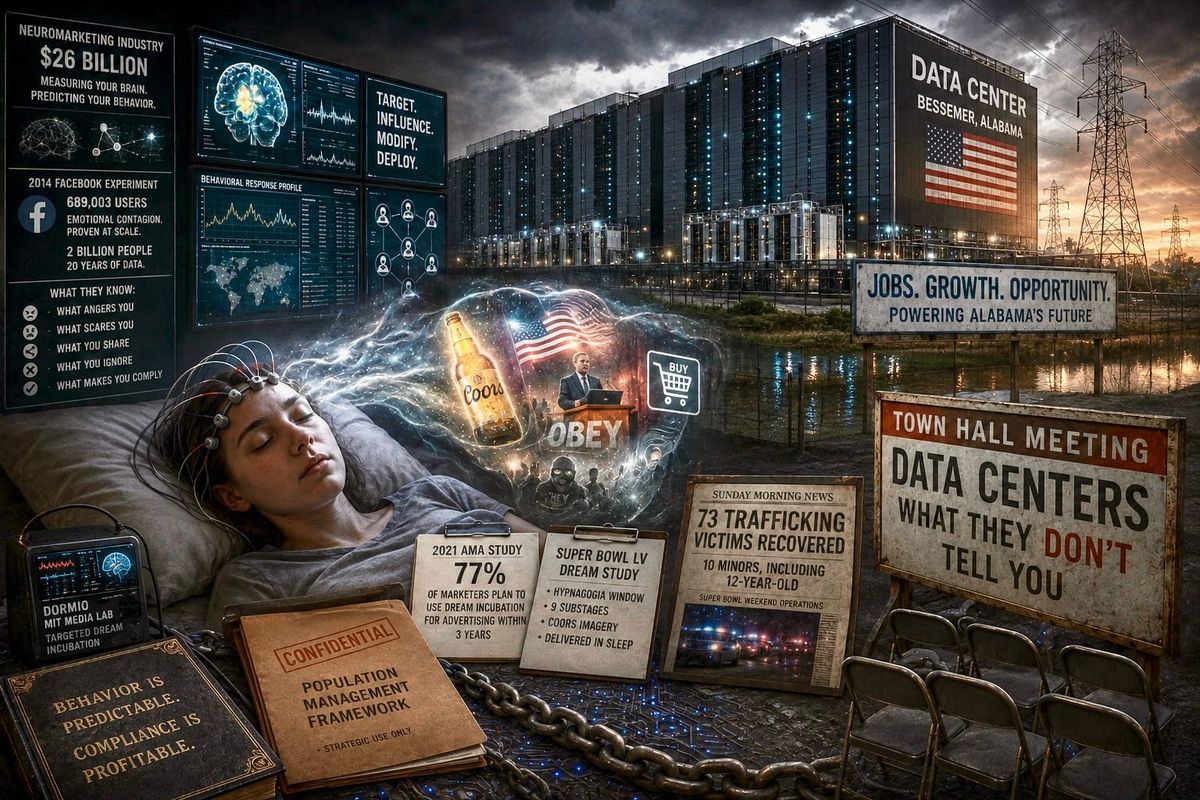
There is currently a $26 billion industry called neuromarketing built around one core capability: measuring brain activity directly — using EEG and fMRI — to determine what people respond to before they consciously know they're responding to it. Not what they say they'll do. What their brain actually does. This industry doesn't need new data centers to exist. It already exists. But scaling it — deploying it across an entire population, processing the neural response data of millions of people simultaneously, storing the results, and using them to calibrate future delivery — requires exactly the kind of infrastructure currently being proposed for Alabama communities.
Then there is the next layer.
In 2021, the night before Super Bowl LV, Molson Coors ran what they called the world's largest dream study. They hired a Harvard psychologist, recruited participants, and used a device developed at MIT's Media Lab to pipe imagery of Coors beer into their sleeping minds during the transitional state between wakefulness and sleep — a window neuroscientists call hypnagogia, across nine substages of sleep onset, during which the brain maintains sensitivity to outside stimuli even as it enters a more dream-like state.
The device is called Dormio. The protocol is called Targeted Dream Incubation. It works. MIT's own research found that participants prompted to dream about specific themes showed 43% greater creativity than those who napped without direction and 78% more than those who stayed awake.
That night — the same night Coors was engineering beer dreams — law enforcement in the host county recovered 73 trafficking victims. Ten of them were minors. One was twelve years old. By Sunday evening the conversation was about the game. By Monday it was over entirely.
But the dream study continued. A 2021 American Marketing Association survey found that 77% of more than 400 marketers from U.S. firms plan to deploy dream incubation technology for advertising within three years. This is not fringe. This is the mainstream marketing industry announcing its intentions in a formal research publication.
The data centers being proposed for Alabama communities are the processing and storage backbone that makes deploying this at population scale possible.
They Already Have the Targeting Data
Here is what makes this more than theoretical.
In 2014, Facebook ran a psychological experiment on 689,000 users without their knowledge or consent. They manipulated News Feeds to show users either more positive or more negative content and measured whether it changed the emotional tone of users' own subsequent posts. It did. They published the results in a peer-reviewed journal under the title "Experimental evidence of massive-scale emotional contagion through social networks."
They confirmed, on nearly 700,000 unwitting human subjects, that algorithmically delivered emotional content reliably shifts the emotional state and subsequent behavior of the recipient.
Then they kept doing it. For two more decades. On two billion people.
What Facebook accumulated across that time — what every major social platform has accumulated — is the most detailed behavioral response database in human history. What makes you angry. What makes you afraid. What makes you share. What makes you disengage. What emotional content produces what behavioral response in which demographic, in which region, at which time of day, in which political climate.
That is exactly the targeting data you would need to calibrate a dream incubation system for maximum effect. Not maximum beer sales. Maximum behavioral influence. Maximum political compliance. Maximum population management.
They didn't need a lab. They had two billion subjects who told the algorithm exactly how their nervous system responds to every category of emotional stimulus, for free, for years. And they stored all of it. In data centers.
Questions Worth Considering for the Bessemer Meeting
The economic development framing assumes the infrastructure serves the community. The evidence suggests the community serves the infrastructure.
Alabama people are already doing everything the expansion is supposedly for — building, creating, publishing, organizing, analyzing — on existing infrastructure that already works. The expansion isn't for them. It's for the layer of behavioral modification, neural data processing, and population-scale targeting that requires orders of magnitude more processing and storage capacity than any individual or small business will ever need.
Coors beer is the least of it.
If the infrastructure can fill your sleeping mind with a product — delivered through the precise neurological window where your critical faculties are offline, calibrated to your documented emotional response profile, processed through a data center in your community — then it can fill your sleeping mind with anything the operator decides to deliver.
A product. A candidate. An enemy. A reason to stay quiet. The feeling that you already agreed to all of this.
That is the question the Bessemer meeting needs to ask. Not whether data centers bring jobs — they do, some. But what exactly is being built, what will it be used for, who controls what it collects, and what does that mean for the people in this community who never consented to hosting it?
Those questions have documented answers. The next five parts of this series lay them out.
Part 2: The Doctrine Behind the Infrastructure — someone named all of this in 1980, and the company that supplied the original program's pharmaceutical backbone just broke ground in Huntsville. They Weren't Hiding It — full historical documentation
Alicia Haggermaker is an investigative journalist, systems analyst, and community organizer based in Huntsville, Alabama. She publishes at Unprecedented Times (unprecedentedtimes.org) and is the founder of the Mycelium Network — a sovereign community coordination platform built as an alternative to the infrastructure this series documents.
unprecedentedtimes.org | mycelium.unprecedentedtimes.org
Sources:
MIT Media Lab Dormio and Targeted Dream Incubation project documentation; Haar Horowitz et al., "Targeted dream incubation at sleep onset increases post-sleep creative performance," Scientific Reports (2023); American Marketing Association Future of Marketing study (2021); Molson Coors Super Bowl LV dream study documentation; Kramer et al., "Experimental evidence of massive-scale emotional contagion through social networks," PNAS (2014); IDTechEx BCI market projections; Market Research Future neuromarketing technology market report (2024–2025); Santa Clara County DA Human Trafficking Task Force, Super Bowl LX operations report (2026); Assembled With Dependency series, AL Politics (2026) "Coming From China": Who's Really Foreign in Alabama's Data-Center Fight ; Show Me On This Doll Where The America First Parts Are , Unprecedented Times (2026).
The Assembled with Dependency series may be read at the following links: Part 1 — Part 2 — Part 3 — Part 4.
Opinions do not reflect the views and opinions of ALPolitics.com. ALPolitics.com makes no claims nor assumes any responsibility for the information and opinions expressed above.