The Job Market Is Worse Than Washington Admits
Weak hiring, automated screening, ghost jobs and slanted visa recruitment have left many Americans locked out of real work
TL;DR: America’s 4.1% unemployment rate masks a far weaker job market. Employers are reluctant to hire, applicants may submit hundreds of résumés for one offer, and some listings are “ghost jobs” that companies have no real intent to fill. Young workers face shrinking entry-level opportunities, AI displacement and a 42% underemployment rate among recent college graduates. Some firms have also used visa recruitment practices that unfairly deter American applicants. When joblessness, forced part-time work and poverty-level wages are included, LISEP estimates that 24.9% of the labor force is functionally unemployed—nearly one in four Americans.
America has entered a “low hire, low fire” economy.
Workers who already have stable jobs are mostly keeping them. But those trying to enter the labor market, return after an absence or escape a poor job face a far more brutal reality.
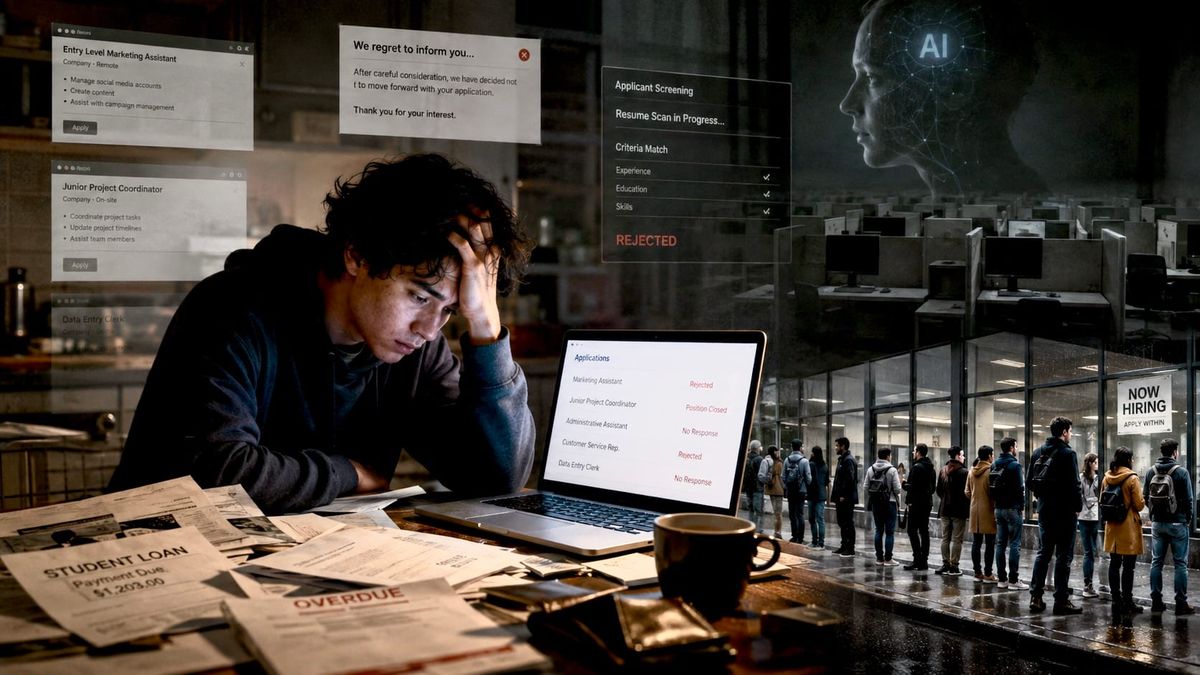
Employers are reluctant to hire. Online openings can draw hundreds or even thousands of applicants. Automated systems reject candidates before a person reviews their résumé. Some advertised jobs may not exist at all.
The Trump administration can still point to an official unemployment rate of 4.1%. Yet that number says little about how hard it has become to land a stable, full-time job that pays enough to live on.
The deeper weakness becomes clear in the hiring data.
Employers cut 23,000 nonfarm jobs in July. The labor force participation rate fell to 61.4%, down 0.7 percentage points since January. The share of the population with a job also declined, according to the Bureau of Labor Statistics.
Layoffs remain fairly low, but companies are not adding many workers. That protects those already inside the labor market while raising the barriers for everyone else.
The latest federal benchmark revision added to the concern. The Bureau of Labor Statistics (BLS) now estimates that the economy had 79,000 fewer jobs in March than first reported. The total revision was modest, but estimated private-sector employment was cut by 178,000 jobs.
The change lowered average private job growth during the prior 12 months from 38,000 to 24,000 jobs per month. Retail employment alone was revised down by 154,600 jobs, according to Reuters.
That is not proof federal officials falsified the numbers. Monthly job reports are estimates and are revised as better records arrive.
It does show that the private job market was weaker than Washington first reported.
Businesses face high costs, tariffs, uncertain trade rules and questions about whether artificial intelligence will allow them to operate with fewer workers. Those forces encourage employers to wait rather than hire.
Job seekers pay the price.
According to Gem’s 2026 Recruiting Benchmarks Report, just 0.5% of applicants were hired — roughly one successful applicant for every 200 applications. Gem based its findings on data covering more than 165 million applicants and 1.2 million hires.
A 0.5% success rate for applicants has become a grim shorthand for the current job search. At that rate, an applicant would need to submit about 200 applications to receive one offer, assuming the 0.5% success rate holds.
There is no complete national database proving that 0.5% is the standard rate for every applicant. The odds vary based on the field, location, applicant and quality of each submission. But, the figure is believable to many Americans who have sent hundreds of résumés and received little more than automated rejection emails.
Online systems have made it easy for thousands of people to apply for the same position. Artificial intelligence can now create résumés, draft cover letters and submit applications at a vast scale.
Employers, in turn, rely on software to filter the flood before a human being reads most of it.
One recruiter recently said a position that once attracted about 100 applicants can now draw more than 1,000, many produced or submitted with AI tools. The result is a broken system in which qualified applicants are lost in the pile while recruiters struggle to identify serious candidates.
Connections have become more important as a result. An applicant with an internal referral or a direct link to a hiring manager can move around the automated gatekeepers. A person without that network may never receive a fair look.
That puts young workers, recent graduates and people changing careers at a clear disadvantage.
Artificial intelligence is beginning to remove some of the entry-level work that once allowed young employees to gain experience.
A Dallas Federal Reserve analysis cited payroll research showing that employment among workers ages 22 to 25 in occupations most exposed to AI had fallen 13% since 2022.
The Dallas Fed found that AI’s effect across the full labor market remained limited. The impact was clearer, however, among young people trying to enter AI-exposed fields.
A separate U.S. Census Bureau working paper found a large and lasting decline in early-career hiring in industries with high AI exposure after ChatGPT arrived.
Employment among workers ages 22 to 24 in the most exposed industries fell 12% over the following 10 quarters.
That does not mean AI caused every lost job. Businesses had already begun changing the way they hire, train and assign entry-level work. Economic uncertainty, high costs and slower growth also played roles.
But the traditional first rung of the career ladder is disappearing.
Companies once hired young workers with limited experience and trained them. Many now demand years of experience for jobs still described as entry level. Others use software to perform the routine tasks once assigned to new employees.
AI is sawing off the bottom rung of the career ladder. Federal and private payroll data show sharp declines in employment among young workers in the fields most exposed to AI, while older workers in the same occupations have largely held their ground. Anthropic CEO Dario Amodei warns that half of all entry-level white-collar jobs could disappear within five years.
Recent college graduates have been hit especially hard.
Their unemployment rate stood near 5.6% during the second quarter of 2026. Their underemployment rate reached 42%, according to the Federal Reserve Bank of New York.
That means more than 4 in 10 employed recent graduates were working in jobs that normally do not require their degrees.
They did what they were told. They went to college, earned a degree and often took on debt. Many now find themselves waiting tables, making coffee, stocking shelves or working other survival jobs while trying to enter the careers for which they trained.
Some of the openings drawing hundreds of applications may not be openings at all.
“Ghost jobs” are listings for positions that do not exist, have already been filled or are not expected to be filled soon.
Companies may post them to collect résumés, test the supply of labor, suggest that the company is growing or keep a hiring pipeline ready for some future date. A listing may also remain online after a hiring freeze or change in the company’s plans.
One study estimated that up to 21% of job advertisements may be ghost jobs. The problem appeared more common among large firms and in fields requiring specialized skills.
A Congressional Research Service report warned that ghost listings waste applicants’ time, damage their confidence and may distort official measures of job openings.
For someone who has spent an hour tailoring a résumé, writing a cover letter and completing an online test, the employer’s motive makes little difference.
The advertised opportunity was never real.
The practice has drawn enough concern that Texas Attorney General Ken Paxton opened an investigation into LinkedIn in July. His office is examining whether the platform misled paying users by promoting jobs that were fake, inactive or posted with no intent to hire.
The investigation has not established that LinkedIn broke the law. It does show that ghost jobs have become more than an online complaint.
They are now a public-policy and consumer-protection issue.
Some American workers also suspect that certain jobs are advertised only to satisfy immigration rules before a company hires or retains a foreign worker.
That concern has a factual basis, but the visa programs must be distinguished.
Most employers seeking an H-1B worker are not required to recruit American workers first. Recruitment is required for companies heavily dependent on H-1B labor or previously found to be willful violators, according to the Department of Labor.
Those employers must recruit in good faith. They cannot favor an H-1B applicant over an equally or better-qualified American worker.
The broader advertising requirement more often arises under the Permanent Labor Certification program (PERM).
PERM allows a company to sponsor a foreign worker for permanent residence after showing that it could not find a willing and qualified American for the position.
In those cases, the employer must advertise the job and consider American applicants.
That system creates an obvious risk if the company has already selected the foreign worker and treats the required recruitment as paperwork rather than a real search.
The concern is not merely theoretical.
The Justice Department has brought cases against companies accused of using recruitment methods designed to deter Americans while favoring workers with temporary visas.
In one major case, Apple agreed to a $25 million settlement after the department found that the company used less effective recruitment methods for PERM jobs and required paper applications even though it accepted online applications for other positions.
In May, the department announced that the full $18.25 million back-pay fund had been distributed to American workers harmed by Apple’s prior practices.
The Justice Department has also sued Cloudera, alleging that the technology company created a separate process to deter Americans from applying for high-paying jobs earmarked for temporary visa holders.
The allegations against Cloudera remain unproven as of this writing.
Other cases have ended in settlements.
In April, Compunnel Software Group agreed to pay more than $313,000 to resolve claims that some recruiters used job advertisements that excluded American citizens and permanent residents while favoring H-1B and other temporary visa holders.
The evidence does not show that all ghost jobs are tied to H-1B workers or PERM applications. It also does not show that most employers using foreign labor violate the law.
It does show that some companies have used sham, slanted or needlessly difficult recruitment methods to shut American workers out.
For applicants already battling weak hiring, automated filters and hundreds of rivals, even a small number of jobs advertised merely to complete an immigration process adds insult to injury.
Taken together, weak hiring, automated screening, vanishing entry-level jobs, fake listings and slanted recruitment help explain why the labor market feels far worse than the official numbers suggest.
The federal unemployment rate stood at 4.1% in July. But that rate answers a very narrow question.
It does not measure whether people can find a suitable job. It does not measure the quality of that job. It does not measure how many applications they submitted, how many listings were fake or how many employers had already selected someone else.
It does not measure whether the paycheck covers the bills.
As ALPolitics.com previously reported, a broader measure from the Ludwig Institute for Shared Economic Prosperity (LISEP) found that 24.9% of the American labor force was “functionally unemployed” in July — more than six times the federal government’s official rate.
LISEP’s True Rate of Unemployment counts people who have no job, cannot find the full-time work they want or earn less than $26,000 per year before taxes.
That income line is measured in 2025 dollars and works out to about $2,167 per month before taxes.
The functional unemployment rate rose for four straight months through July. It climbed from 24.7% in June to 24.9% in July and was up 1.3 percentage points since March.
In plain terms, nearly one in four people in the labor force either lacked a job, could not obtain enough hours or earned too little to meet a basic living-wage standard.
“Washington can call these people employed, but try paying rent, food, insurance, utilities, transportation, and medical expenses on barely $2,000 per month before the government takes its share,” Armstrong Economics wrote.
The official unemployment rate, known as U-3, only counts people who have no job, are available to work and actively sought employment during the prior four weeks.
A person who gives up searching is generally no longer counted as unemployed. A person who worked as little as one hour during the survey week may be counted as employed.
The BLS reported that 5.9 million Americans outside the labor force still wanted a job in July. They were excluded from the unemployment count because they had not looked recently or were not ready to begin work at once.
Another 4.8 million were working part time for economic reasons. They wanted full-time jobs but could not find them or had seen their hours cut.
Even the government’s broadest measure, known as U-6, stood at 7.9% in July. It includes discouraged workers, people with a weak tie to the labor force and those forced to settle for part-time work.
It still excludes full-time workers whose earnings fall below LISEP’s living-wage line.
Critics are right to note that LISEP’s 24.9% rate is not a second estimate of how many Americans have no job. It combines joblessness, short hours and low pay into one measure.
Those are distinct problems.
They are also real problems.
Functional unemployment stood at 31% among women in July, compared with 19.5% among men. It reached 27.3% among Black workers, 26.7% among Hispanic workers and 23.8% among White workers.
Education helped, but it did not solve the problem. LISEP found functional unemployment rates of 50.3% among workers without a high school diploma, 28.5% among high school graduates, 16.8% among those with bachelor’s degrees and 12.8% among workers with advanced degrees.
“We shouldn’t read too much into a single month, but four months begin to tell a story,” LISEP Chairman Gene Ludwig said. “Functional unemployment is moving higher while workforce participation is moving lower. If this continues, it would suggest the labor market is losing strength despite what we may see in the headline unemployment numbers.”
The United States is not suffering mass unemployment in the classic sense. Most Americans who have jobs are keeping them.
But the country does have a weak hiring market. Millions of people remain trapped in low-paid or part-time work. Recent graduates cannot begin stable careers. Job seekers can submit hundreds of applications without receiving an offer, sometimes for positions that were never going to be filled.
The official rate asks whether Americans have jobs.
The 24.9% rate asks whether those jobs are enough to live on.
Washington can continue pointing to 4.1%.
The people sending their 200th application know better.