Alabama Appeals Redistricting Ruling to High Court
State leaders ask the U.S. Supreme Court to restore Alabama’s 2023 congressional map ahead of the 2026 elections
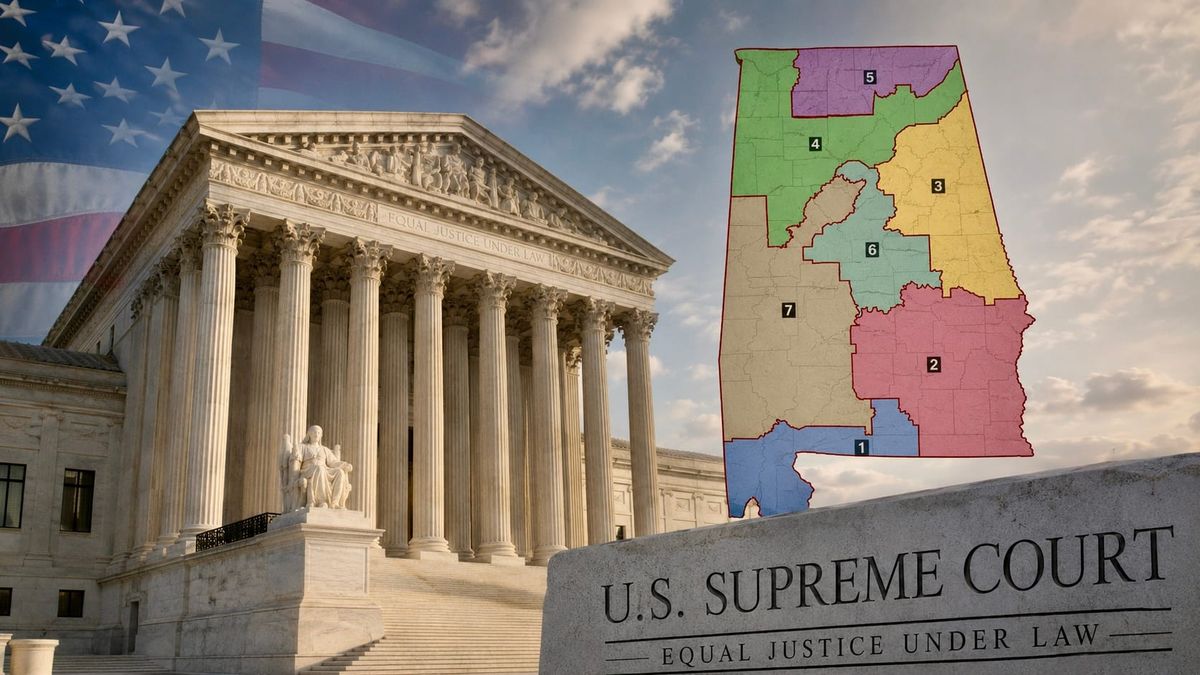
Alabama officials are again asking the U.S. Supreme Court to step into the State’s long-running congressional redistricting fight, filing emergency stay applications after a federal court blocked the use of Alabama’s 2023 congressional map earlier this week.
In filings submitted Wednesday, Alabama Attorney General Steve Marshall asked the nation’s highest court to pause a May 26 ruling from a three-judge federal panel that barred the State from using its Republican-drawn congressional districts in the 2026 elections.
The applications were filed in Allen v. Singleton, Allen v. Caster, and Allen v. Milligan. The cases stem from a years-long legal battle over whether Alabama’s congressional maps unlawfully diluted the voting strength of Black residents under Section 2 of the Voting Rights Act.
The federal court ruled this week that Alabama’s 2023 map was intentionally discriminatory and ordered the State to continue using the court-drawn map first implemented during the 2024 election cycle. That map created a second district where Black voters hold substantial influence, leading to the election of Democratic Congressman Shomari Figures.
Marshall sharply criticized the ruling in a statement released by the Alabama Attorney General’s Office.
“Yesterday’s decision was disappointing but was not surprising. The Supreme Court made it clear in Callais that courts should not impose or require States to draw racially gerrymandered congressional maps. But the three-judge district court set that rule aside and once again replaced Alabama’s map with one that sorts voters based on race,” Marshall said.
“The extent to which there is confusion about the maps which Alabama uses for congressional districts seems to be with the three-judge panel, not the voters. The fact that our State’s conservative electorate has conservative representation is democracy, not an attack on it.”

Marshall also argued the State should return to a fully Republican congressional delegation.
“I believe we should have a 7-0 Republican congressional delegation that reflects Alabama’s voters and complies with the Supreme Court’s ruling in Callais, and a stay from this decision is now the best avenue to achieve that goal. If the court will not uphold the law, I am confident that the Supreme Court will.”
The emergency applications were directed to U.S. Supreme Court Justice Clarence Thomas, who handles emergency matters arising from the Eleventh Circuit. Alabama officials asked the court to issue a ruling before June 1 and requested an immediate administrative stay while the case moves forward.
The latest filing follows a rapid series of legal and political developments tied to the Supreme Court’s recent decision in Louisiana v. Callais. That ruling altered how courts evaluate racial discrimination claims in redistricting disputes and prompted Alabama officials to argue that earlier injunctions against the State’s maps should be lifted.
Earlier this month, Alabama officials sought emergency relief from federal courts after the Callais decision, claiming the new legal standard favored the State’s position. A federal panel later ruled that only the Supreme Court could resolve the dispute moving forward.
The redistricting fight dates back to 2021, when voting rights groups challenged Alabama’s congressional boundaries after the State adopted a map containing only one majority-Black district, despite Black residents making up roughly 27 percent of Alabama’s population. In 2023, the Supreme Court upheld a lower court finding that Alabama likely violated the Voting Rights Act by failing to create a second district where Black voters could elect candidates of their choice.
Lawmakers later approved a revised 2023 map, but federal judges ruled it still failed to comply with court orders. The court eventually imposed its own map for the 2024 elections after concluding the Legislature had not produced a lawful replacement.
The dispute now returns to the Supreme Court as Alabama prepares for special congressional primaries scheduled for August. Governor Kay Ivey has already adjusted portions of the election calendar while awaiting further court action.