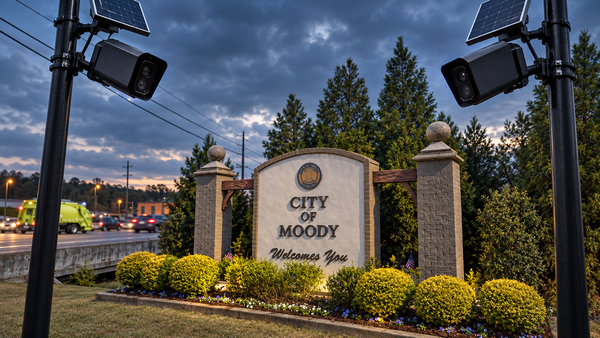
DC Police Union Turns Against Flock Surveillance
D.C. officers object after learning Internal Affairs used Flock cameras to track police — the same tool used to watch the public
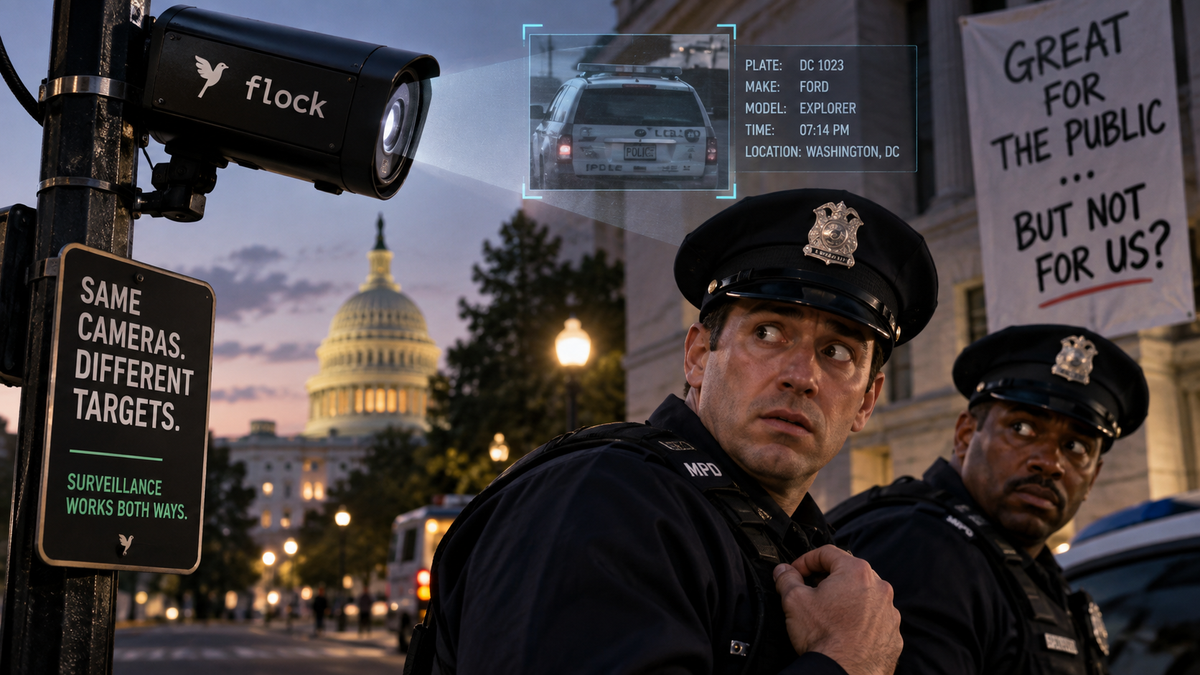
TL;DR: D.C.'s police union is challenging MPD after learning Internal Affairs used Flock license plate cameras to track officers under investigation. The union is demanding tighter controls, transparency and scrutiny of possible constitutional issues — concerns privacy advocates have raised for years about police tracking ordinary citizens. The Institute for Justice's database now contains 239 reported ALPR abuse incidents, including alleged stalking and personal searches by police. The clash puts police on an unusual side of the surveillance debate: objecting to being watched by a system law enforcement has widely used to watch everyone else.
Police unions aren’t exactly known for warning about the dangers of police surveillance.
Flock cameras may be changing that.
The D.C. Police Union is fighting the Metropolitan Police Department (MPD) after learning that Internal Affairs investigators used automated license plate readers to track the movements of officers under investigation — without telling them.
The dispute represents an awkward turn in the growing national fight over Flock Safety. Police agencies have long defended license plate readers as useful tools for finding stolen cars, locating missing people and tracking suspects. Now, some D.C. officers are raising many of the same privacy and oversight concerns that civil-liberties groups have raised on behalf of the public.
According to The Record, union officials learned in July that MPD's Internal Affairs Division had used Flock data to determine the whereabouts of sworn officers who were under investigation. Privacy advocates told the outlet they knew of no prior case in which a police department had used Flock to monitor its own officers.
MPD defended the searches.
The department's “position is that the use of LPR in the misconduct investigation was appropriate,” MPD said in a statement.
The union sees things quite differently.
“A system with such broad and extensive capabilities requires not only significant guardrails but also full transparency with the public,” D.C. Police Union President Gregg Pemberton said. “The MPD has provided neither.”
The union filed a grievance demanding that MPD stop using the system to track officers. Management denied it, according to the union, and the dispute is now headed to arbitration.
There was, however, an interesting development. The same day the grievance was denied, MPD issued what the union described as “a new teletype restricting department-wide access” to the system. MPD would not comment to The Record about those claimed restrictions or their timing.
The controversy goes beyond whether police supervisors should be able to track officers.
Pemberton told The Washington Post that the union has “a lot of concerns about whether or not there’s a constitutional question that needs to be addressed” with Flock's use more broadly.
“Once you start to understand the capabilities of this system, even the proponents of it say there needs to be more public discussion and probably more legislation on it,” he said.
That argument is all too familiar to Flock's critics.
Flock's automated license plate readers photograph passing vehicles and record data that can include the plate, vehicle image and traits, date, time and camera location. The information can then be searched by authorized users. Flock's current company policy says data is deleted on a rolling seven-day basis by default, though customers can use different retention periods when required by their own laws or policies.
Police departments argue that the technology can be an effective crime-fighting tool. MPD itself has called license plate readers a “critical tool” and said they help officers find vehicles tied to crimes, missing-person cases and carjackings. In an earlier report, MPD said its LPR network was capturing about 300,000 reads per day.
Flock likewise says its technology assisted more than 1 million investigations and helped locate more than 10,000 missing people during 2025, based on the company's survey of 700 law enforcement agencies.
However, Flock’s claims are disputed, with one report, based on FBI data, claiming that Atlanta’s “massive web of surveillance has had virtually zero impact on the Atlanta Police Department’s ability to solve crime, with some clearance rates for offenses like homicide even experiencing a decline over the past few years as the cameras have proliferated.”
A recent investigation found that hackers who obtained a Flock camera recovered software, logs, videos and still images showing just how much the devices collect. One camera generated about 1.6 million images of roughly 50,200 vehicles during 21 days of recovered logs. The software detected not just license plates, but vehicles, bicycles and people, while some passing cars triggered more than 100 images. The findings provide a far more detailed picture of the system than the simple “license plate reader” label might suggest.
Then there is the question of what happens to all that data. Officials in Sheboygan, Wisconsin, moved to cancel the city's Flock contract after learning that a Flock sales representative had offered the city's Public Works Department up to five years of anonymized traffic data derived from its 15 cameras, including vehicle type, traffic volume and speed information. That raised an obvious question because Sheboygan's agreement specified a 30-day retention period for its Flock data and barred Flock from owning or selling customer data. Flock has said the traffic analytics product is separate from its ALPR data and maintains that it does not sell customer data, so the episode does not by itself prove Flock secretly kept five years of raw license-plate records. But it does seriously complicate the reassuring claim that data captured by these cameras simply disappears after 30 days. Sheboygan apparently found the explanation troubling enough to cover its cameras and move to end the relationship.
Additionally, there is a darker side to giving government employees a searchable database of people's movements.
The Institute for Justice's Database of ALPR Abuse now lists 239 reported incidents involving law enforcement personnel. The cases include alleged stalking, searches for personal reasons, wrongful stops and other misuse.
Some cases are hard to dismiss as theoretical privacy fears.
In Lufkin, Texas, an officer was indicted on 100 felony counts after allegedly searching for his former girlfriend and people she knew more than 10,000 times. In Savannah, Georgia, an officer was accused of making more than 400 searches involving an ex-girlfriend and another person. In Creve Coeur, Illinois, a police chief resigned after allegedly using the system to keep tabs on his ex-wife while she sought an order of protection against him.
The Institute for Justice also says records obtained in litigation involving Norfolk, Virginia, showed roughly 230,000 searches over two years. Search reasons were sometimes vague enough to include entries such as “cj,” “stolen” and “inv.” One officer repeatedly entered “la la la la” as a reason, according to the group.
Those records explains why the D.C. dispute is much more than just a routine labor fight.
Police agencies have often argued that license plate readers are legitimate because cameras capture vehicles traveling on public roads, where drivers have a reduced expectation of privacy. Flock makes much the same case, saying its cameras capture “point-in-time” images rather than continuously tracking a person or vehicle — but when multiple points are combined, they create a pattern that raises significant 4th Amendment questions.
And when that same technology was aimed inward, at police officers themselves, the union quickly began asking about constitutional limits, transparency, safeguards and abuse.
The irony is difficult — nigh onto impossible — to miss.
The union's position adds a new voice to a debate that has spread far beyond traditional privacy groups. The Record reported that more than 200 Flock contracts have been terminated since 2021, citing research from Secure Justice, while Texas and Florida recently imposed new restrictions on the technology.
D.C. Councilmember Brooke Pinto, Chair of the Judiciary and Public Safety Committee, has also demanded answers from MPD about its use of Flock.
“Security and privacy are fundamental rights for our residents — we must always balance the dual important duties of our government to protect the public’s safety and to safeguard our civil liberties,” Pinto said. “The public deserves transparency and must understand how this technology is being used in our communities.”
That question now applies to police officers as well.
Fancy that.
But perhaps, this presents an elegant solution to the problem of constant surveillance by Flocks and other similar cameras and devices.
We just need to turn them on the police…and every elected official and bureaucrat, just like they’ve done to us.
Seems only fair, doesn’t it?