Tuberville shifts course on Alabama data centers
After months of strong support, GOP nominee vows no incentives as data center backlash grows across Alabama and the nation
TL;DR: Tommy Tuberville has sharply toughened his stance on Alabama data centers, shifting from an open-door approach to pledging no tax incentives and requiring developers to pay the full cost of power, water and infrastructure. Democratic rival Doug Jones goes further, calling for a one-year moratorium while Alabama writes new rules. The change comes amid growing bipartisan opposition to data centers across Alabama and an NRSC warning that the issue could cost Republicans a U.S. Senate seat in Ohio. With data centers increasingly politically toxic, Tuberville may be recognizing that Alabama Republicans face the same risk.
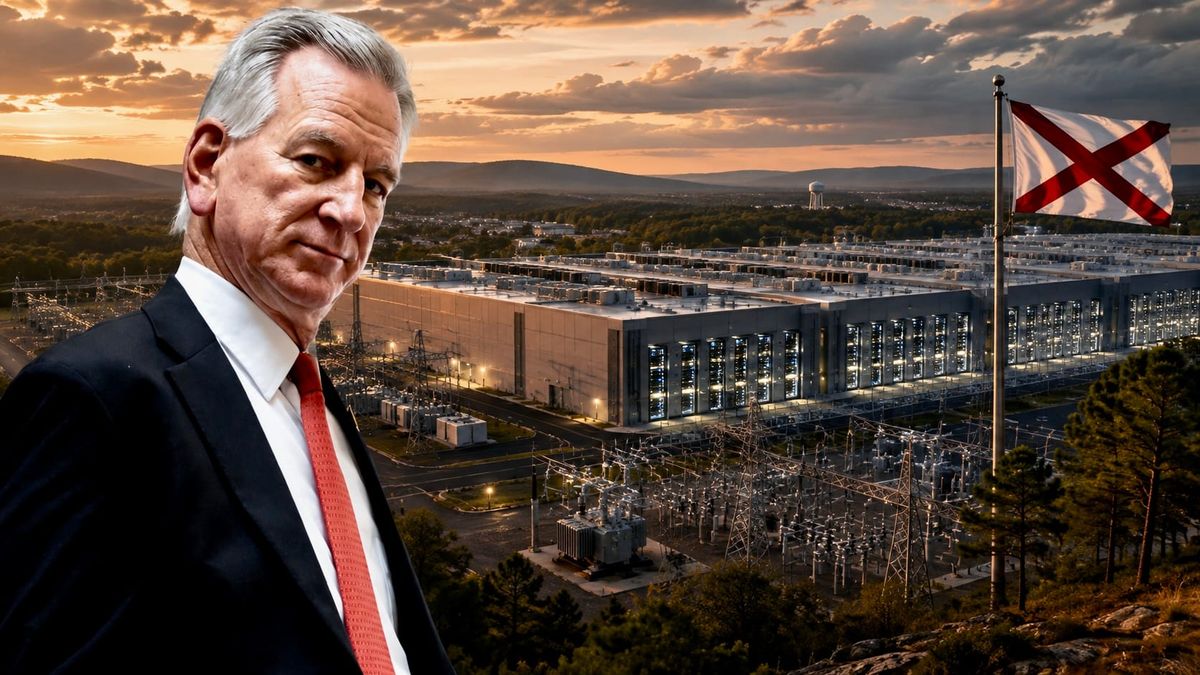
U.S. Senator Tommy Tuberville has sharply toughened his position on Alabama’s fast-growing data center industry, pledging that the multibillion-dollar facilities will receive no tax incentives and will be forced to pay the full cost of the resources and infrastructure they consume.
It is a marked change in tone for the Republican nominee for Governor.
Just weeks ago, Tuberville was one of Alabama’s most vocal boosters of hyperscale data centers. He dismissed some of the concerns raised by residents, blamed part of the opposition on Chinese propaganda and argued that Alabama needed to move quickly or risk surrendering the future of artificial intelligence to China.
Now, his message to Big Tech is considerably less welcoming.
“When I am Governor, data centers will pay for everything,” Tuberville wrote Tuesday in an opinion piece published by Alabama Political Reporter laying out what he called his “game plan” for the industry.
Tuberville said Alabama has spent too much trying to lure the industry and pledged to end the practice.
His new plan calls for no tax abatements or other incentives, full payment for electricity and infrastructure, replacement of power and water capacity used by the facilities and a higher property-tax classification for data centers. He also said local communities — not Montgomery — should have the final say over whether a project is built.
“These companies are already standing at the door. We shouldn’t have to pay them to come inside,” Tuberville wrote.
The change does not put Tuberville in the same camp as Democratic gubernatorial nominee Doug Jones. Far from it.
But it does move the Republican substantially closer to some of the concerns that Jones, local officials and grassroots opponents have been raising for months.
Tuberville’s earlier approach was far more aggressive.
Speaking to the Alabama Sheriffs Association in Opelika in July, Tuberville defended data centers as an important source of tax revenue for schools, law enforcement and other public services.
He also brushed aside some of the criticism.
“I think there are 27 States that said we aren’t going to build data centers — we’re not going to do that,” Tuberville said. “It makes too much noise. It’s going to ruin the climate — bull crap. They are listening to all this nonsense they see on social media that’s coming from China because China does not want us to grow.”
At the time, his core message was clear: Data centers were coming, Alabama should welcome them and the State should not allow environmental or community opposition to drive them elsewhere.
Tuberville has since added a long list of conditions to that welcome.
His Sept. 1 proposal says there should be “no more tax abatements” and “no more tax incentives.” He wants data centers to pay for new transmission lines, substations and water systems. He wants companies to replace the power and water capacity they consume. He says local communities should be able to say no.
He also proposes placing data centers in Alabama’s highest property-tax class.
That would represent a major break from Alabama’s long-standing effort to recruit the industry with tax breaks.
The Alabama Department of Revenue says qualifying data processing centers have been eligible for property and sales-tax abatements lasting as long as 30 years. The 30-year provisions apply to qualifying data centers granted abatements before Jan. 1, 2027.
Alabama lawmakers also moved during the 2026 session to trim some of those incentives. HB399 limited portions of the package available to large data centers, including projects with very high power demand.
Tuberville is now proposing to go further.
“If you want to come to Alabama, you pay full price,” he wrote.
Jones has taken a different route.
Rather than continue approving projects under tighter rules, the former U.S. Senator has called for a one-year Statewide moratorium on new AI data center projects while Alabama develops rules covering power costs, water use, transparency, environmental effects and local control.
Jones formally included the moratorium in his July policy agenda.
The proposal would stop new approvals for a year while the State creates safeguards aimed at protecting taxpayers, utility customers, natural resources and communities. His plan also calls for a ban on nondisclosure agreements between data center developers and government bodies, public impact studies, disclosure of project ownership and a searchable database of abatements and large-load power contracts.
Jones has since made the issue a major piece of his campaign.
“The biggest thing we’re seeing right now crosses political lines, racial lines, the urban-rural divide; it’s the data center issue,” Jones said during an August television appearance. “People are upset about the data centers being planned in their communities, and they want a moratorium, which is exactly what I’ve called for.”
Tuberville rejects that approach.
He argues that AI infrastructure is too important to freeze, even temporarily, and says Alabama can continue building while making developers pay their own way.
That leaves voters with two increasingly distinct proposals.
Jones wants to hit pause, write the rules and then decide which new projects should proceed.
Tuberville wants construction to continue, but under a much tougher financial and regulatory framework than the one he appeared to embrace earlier this summer.
The shift comes as data centers have become one of Alabama’s rare political issues that does not divide neatly along party lines.
That was on display at a recent ALPolitics.com forum at New Hope Cumberland Presbyterian Church in Indian Springs Village.
ALPolitics.com described the Aug. 17 event as bipartisan and said organizers hoped to bring together people “of all political persuasions” to discuss data centers, Flock cameras, artificial intelligence and their effect on Alabamians. Speakers included Alabama Legislative Watchdog radio host Ann Eubank, investigative journalist Alicia Haggermaker, Hoover Democrats Chair Liz Lane and ALPolitics.com Managing Editor Dr. Bill Chitwood.
That unusual mix reflects what is happening elsewhere in Alabama.
Conservatives worried about property rights, government secrecy and utility costs have often found themselves raising similar concerns as Democrats and environmental groups focused on water, pollution and energy use.
Other critics question the economics.
Data centers require vast capital investment but comparatively few permanent workers.
ALPolitics.com recently reviewed several Alabama projects and found that Meta’s Montgomery data center grew from an announced investment of about $800 million to more than $1.5 billion while the expected permanent workforce remained only a little above 100. Meta’s Huntsville campus represents another $1.5 billion-plus investment and roughly 300 operational jobs.
The article found that data centers often produce thousands of temporary construction jobs but comparatively few permanent positions once a facility begins operating.
The contrast is even more striking in Bessemer.
No Alabama project has generated more controversy than Project Marvel.
The proposed QTS hyperscale campus has been described as a roughly $14.5 billion project that could ultimately include 18 large buildings. Estimates put its possible power demand near one gigawatt, or roughly the amount of electricity needed to serve about 1 million homes. Permanent employment has been estimated at about 330 jobs.
The project has also become a case study in what critics say Alabama has done wrong.
Residents have objected to secrecy surrounding the development, possible water use, noise, traffic, forest clearing, energy demand and the effect on surrounding homes.
The controversy grew after Bessemer officials released a nondisclosure agreement tied to the project only after environmental groups threatened litigation. The NDA covered information about the developer, site plans, studies and other records and included a provision requiring the city to destroy copies of information considered confidential when requested by the developer.
Project Marvel may already have had political consequences.
Bessemer Mayor Kenneth Gulley acknowledged after the August municipal election that the project likely affected the vote.
“You know when you’re in politics there are various issues that can come up in an election. Do I think that Project Marvel played a part in it? Yes, I do,” Gulley said.
The early council results offered some support for that view. ALPolitics.com reported that Councilwoman Sarah Person and Councilman Teco Stephens, both supporters of Project Marvel, were defeated, while another supporter faced a razor-thin result. Councilman Cleo King, who opposed the project, received nearly half the vote in his race.
And Bessemer is hardly alone.
Brookwood residents have packed meetings over a major data center project in Tuscaloosa County, raising concerns over water, land use, transparency and the location of the project near existing neighborhoods and schools.
Birmingham went so far as to impose a temporary moratorium while city officials wrote a new regulatory framework. The City Council later approved 20 conditions for future hyperscale data centers covering noise, water use, power demand, setbacks, diesel generators and notice to nearby property owners.
Across Alabama, concerns increasingly center on who will pay for new power generation and transmission, how much water the facilities will consume, round-the-clock noise, emissions from backup generators, public transparency and whether rural communities have enough zoning power to control where the projects are built.
What began as a handful of local zoning disputes has become a Statewide political issue.
And Alabama is not unique.
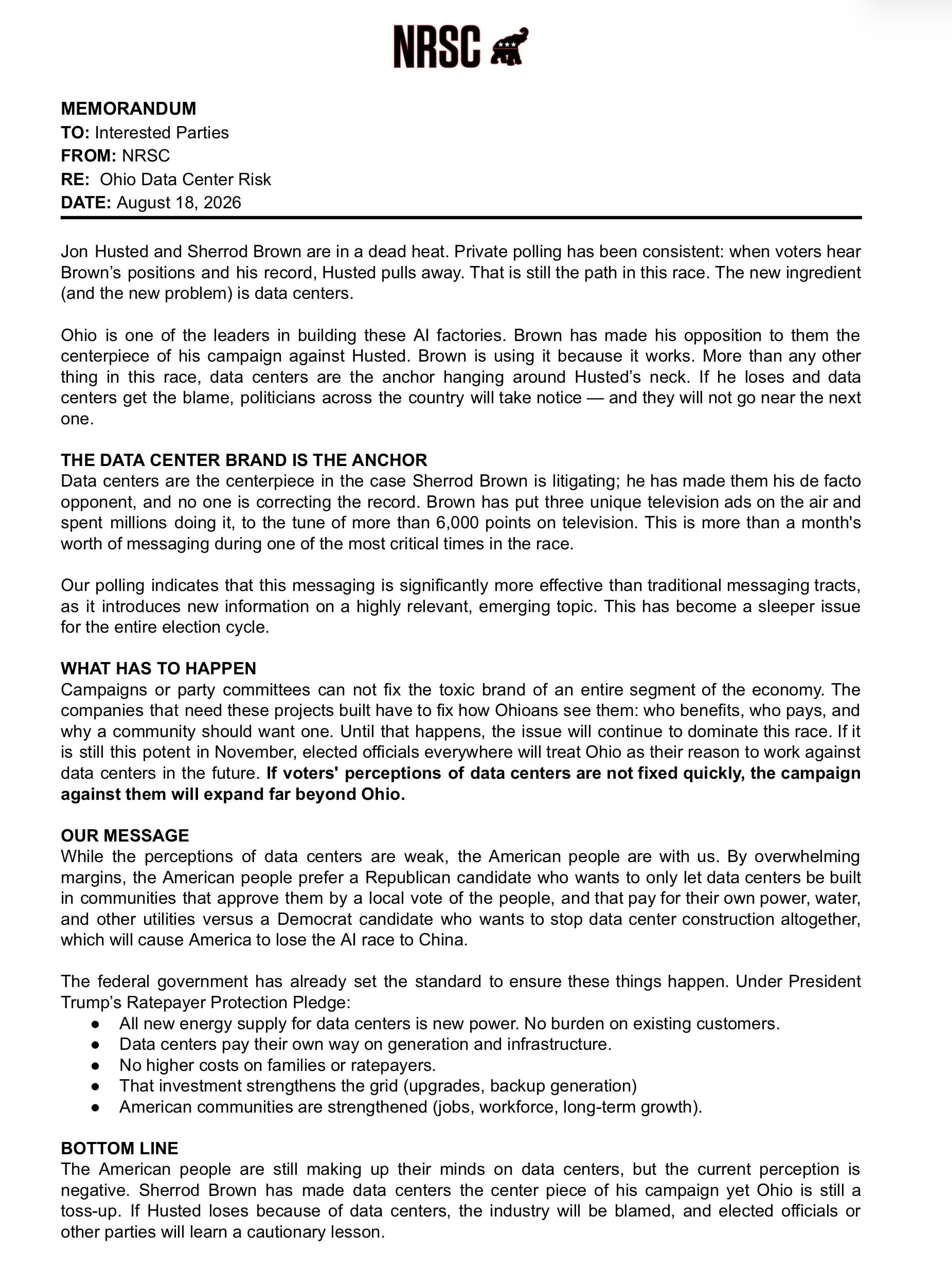
Perhaps the clearest sign of how politically dangerous data centers have become came not from environmental activists or Democrats, but from the National Republican Senatorial Committee.
The Senate GOP campaign arm issued an extraordinary August memo warning that anger over the facilities could hurt Republican Sen. Jon Husted in his Ohio race against former Democratic Sen. Sherrod Brown.
“More than any other thing in this race, data centers are the anchor hanging around Husted’s neck,” the NRSC memo said.
Axios, which first reported on the memo, said Republican internal polling found data centers were viewed about as negatively as spent nuclear waste and had become a stand-in for broader public unease about artificial intelligence.
The national scale of the issue helps explain the concern.
Axios reported that more than 4,000 data centers are already operating across the United States and more than 3,000 additional facilities are proposed or under development.
In Ohio, Brown has made the issue part of his campaign against Husted, portraying the Republican as closely tied to the industry. Signal Cleveland described data centers as an “animating force” in Ohio politics, with residents “of all political stripes” showing up at local hearings to oppose projects.
The NRSC’s warning is significant because it suggests Republican strategists no longer see data center opposition as a fringe environmental cause.
They see it as an election issue — and possibly a dangerous one for them.
That makes the timing of Tuberville’s change difficult to ignore.
There is no evidence that Tuberville changed his position because of the NRSC memo, and it would be improper to suggest that the two are causally related.
However, the political landscape around him has obviously changed.
In mid-July, Tuberville was attacking some data center criticism as “bull crap” and blaming Chinese influence for opposition.
By Sept. 1, his message had become:
“No more tax abatements. No more tax incentives.”
He now says data centers should pay the total cost of their transmission lines, substations and water systems. They should replace the power and water capacity they consume. They should pay full taxes. Communities should have the power to reject them.
Meanwhile, Alabama cities and towns have been debating moratoriums and tighter rules. Residents have packed public meetings. The Bessemer fight spilled into a municipal election. The economics of generous tax breaks for relatively small numbers of permanent jobs have come under greater scrutiny.
An ALPolitics.com event deliberately brought together people from different ends of the political spectrum over many of the same concerns.
And the Republican Party’s own Senate campaign committee has privately warned that data centers may be politically toxic enough to cost the GOP a Senate seat in Ohio.
Tuberville still wants the data centers.
But, his pitch has changed.
No abatements. No incentives. No subsidized infrastructure. No higher power bills for families. Local communities get a say. Big Tech pays full freight.
That is not Doug Jones’ moratorium.
It is also not the message Tuberville was delivering six weeks ago.
Whether the change reflects policy evolution, voter feedback, campaign politics or some combination of “all of the above” is something only Tuberville can answer.
But Republican strategists have already reached one conclusion in Ohio: Voters are angry about data centers, and politicians who fail to notice may pay for it.
Tuberville may be recognizing that the same warning applies in Alabama.
The NRSC memo is attached below: