
Section 219 and the Sovereignty Question
The Infrastructure Is the Argument — Part 4 of 6. Guest Opinion by Alicia Haggermaker
Guest Opinion by Alicia Haggermaker
This is Part 4 of a six-part series on Alabama's data center buildout and what it actually enables. Part 1 established what the infrastructure is actually for. Part 2 traced the doctrine behind it. Part 3 documented who controls what it collects — a CIA-seeded surveillance company formally partnered with a foreign military intelligence apparatus, processing data with no meaningful transfer limits, run by a man whose co-investor holds a White House position designing the policy it executes. This part documents what Congress just did to make all of that permanent.
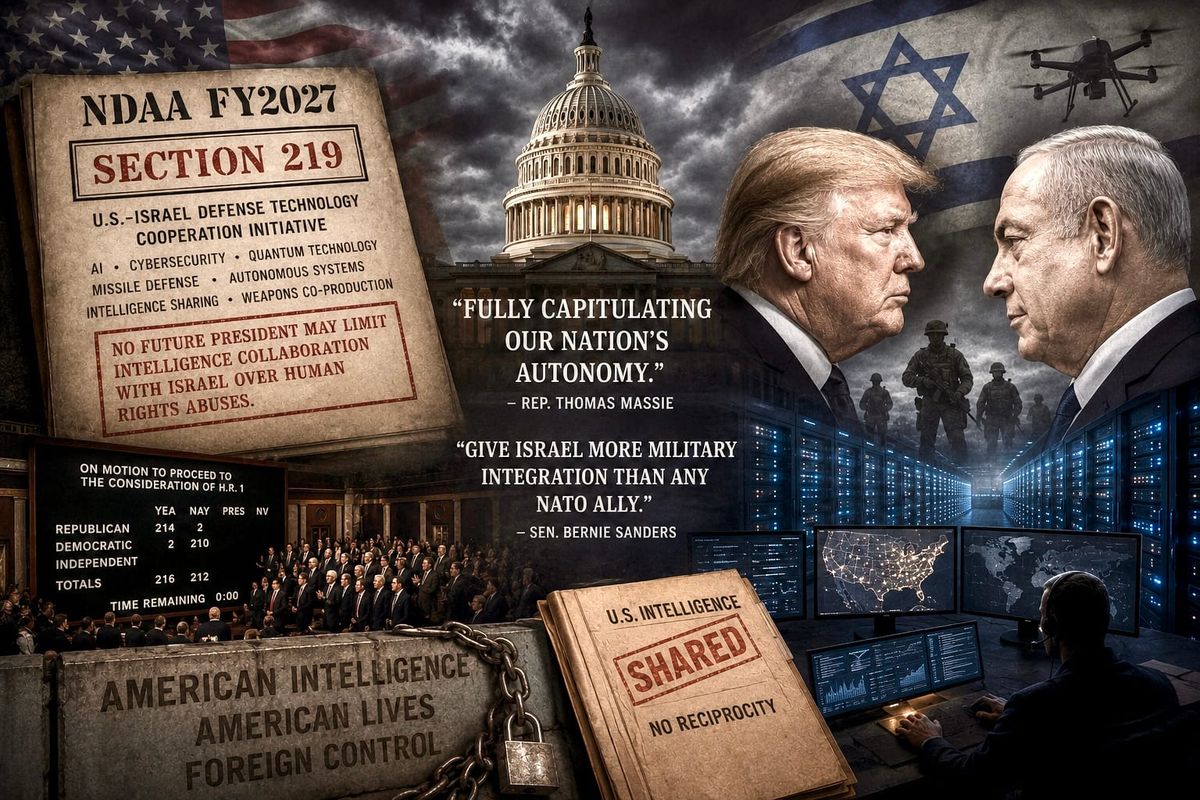
On July 21, 2026, the House of Representatives voted to proceed with the Fiscal Year 2027 National Defense Authorization Act — the annual defense spending bill, this year totaling approximately $1.1 trillion — with a provision called Section 219 still embedded inside it.
A bipartisan amendment to remove Section 219 was submitted by Representative Thomas Massie of Kentucky and Representative Ro Khanna of California. The House Rules Committee declined to allow it a floor vote. The full House voted 216 to 212 to proceed under those rules — meaning the amendment was blocked without debate, without a recorded vote on the substance, and without most Americans knowing it existed.

Section 219 is eleven pages inside a 1,100-page bill.
Here is what it does.
What Section 219 Actually Does
Section 219 establishes the United States-Israel Defense Technology Cooperation Initiative — a permanent framework for integrating portions of the American and Israeli defense industrial bases through expanded cooperation in artificial intelligence, autonomous systems, cybersecurity, quantum technology, missile defense, electronic warfare, biotechnology, and weapons co-production.
It incorporates the FUTURES Act — the United States-Israel Framework for Upgraded Technologies, Unified Research, and Enhanced Security Act of 2026 — directing the Secretary of Defense to appoint a senior official responsible for coordinating joint research, testing, weapons development, technology integration, and industrial cooperation between the two countries on an ongoing basis.
It requires the United States to share intelligence with Israel across these domains.
And it prohibits any future President of the United States from limiting intelligence collaboration with Israel over its human rights abuses.
That last element is the one worth reading twice. Regardless of what international courts find. Regardless of what changes in public opinion. Regardless of which party controls the White House or Congress. No future President can pull back the intelligence relationship — not for human rights concerns, not for legal findings, not for any reason the provision covers.
Representative Massie described it plainly: "This goes well beyond our pre-existing military relationships, such as with Five Eyes nations, or our more conventional defense partnerships with foreign militaries that are typically limited to information sharing, joint exercises, or bilateral development of specific weapons contracts. This is an unprecedented escalation of foreign involvement." He said its enactment would amount to Congress "fully capitulating our nation's autonomy."
Senator Bernie Sanders put the democratic context on the record: "Only 16% of Americans support arming Israel without restrictions. So what is Congress doing? Burying a provision in the defense bill that would give Israel more military integration than any NATO ally."
There is one more detail that has received almost no coverage and deserves to be stated plainly: the arrangement is not reciprocal. Israel would not be obligated to similarly give the United States access to Israeli intelligence. The sum total of American intelligence — gathered at unknown cost and at documented risk to the lives of US intelligence officers, gathered specifically to protect American national interests — would be opened to officers of a foreign government sworn only to their own country, not to the United States or its Constitution. No equivalent obligation runs the other direction.
The party of small government and America First voted to hand the entire US intelligence apparatus to a foreign government with zero reciprocal requirement. There is no interpretive framework within which that position is consistent with either of those stated principles. Alabama's Republican House members voted yes anyway.
The International Legal Context
It is important to be precise about where things stand legally, because precision matters when the stakes are this high.
The International Court of Justice is currently adjudicating a genocide case brought by South Africa against Israel — formally titled Application of the Convention on the Prevention and Punishment of the Crime of Genocide in the Gaza Strip (South Africa v. Israel). Israel filed its counter-memorial in March 2026. A final merits ruling is not expected until 2027 or 2028 at the earliest. No binding judicial finding of genocide has yet been issued by the ICJ.
Separately, in November 2024, the International Criminal Court issued arrest warrants for Israeli Prime Minister Benjamin Netanyahu and former Defense Minister Yoav Gallant. Those warrants are active.
Separately again, the UN Independent International Commission of Inquiry on the Occupied Palestinian Territory concluded in a September 2025 report that Israel has committed genocide against Palestinians. That is a UN commission finding — a different body from the ICJ, carrying different legal weight, but significant in its own right.
The United States intervened in the ICJ proceedings in March 2026 — filing a declaration alongside Hungary, Namibia, and Fiji. The U.S. intervention did not dispute the court's jurisdiction.
Section 219, if enacted into law, would prohibit any future American President from limiting intelligence collaboration with Israel regardless of what any of these proceedings ultimately find. An ICJ genocide ruling. An ICC enforcement action on the existing warrants. A UN General Assembly resolution. None of it would give a future President the legal authority to adjust the intelligence relationship Section 219 creates — because Section 219 would make that adjustment illegal under American domestic law.
That is not a foreign policy position. That is a permanent legislative constraint on American sovereignty written into the defense authorization bill and buried eleven pages deep inside 1,100.
Why This Is a Sovereignty Argument, Not a Foreign Policy Argument
It is important to be clear about what this series is and is not arguing.
This series is not taking a position on the conflict in Gaza. It is not arguing for or against American support for Israel. Those are contested political and moral questions on which reasonable people hold strong and differing views, and they are not what this series is about.
What this series is about is the architecture of accountability — who controls the infrastructure, who controls what it collects, and who controls the legal framework governing both.
Section 219 is a sovereignty argument that cuts across every political identity.
If you are a conservative who believes in American sovereignty and opposes foreign entanglements — a provision that permanently embeds a foreign government's defense industrial base into American military research and acquisition, in ways no future President can undo, goes further than any existing American alliance including NATO and the Five Eyes nations. Massie, one of the most consistently sovereignty-focused members of Congress, said so explicitly.
If you are a progressive who believes in human rights accountability and congressional oversight — a provision that legally prohibits the executive branch from responding to international human rights findings with any adjustment to its intelligence relationships removes a core accountability mechanism from American foreign policy permanently.
If you are a libertarian who believes in limited government and constitutional constraints on executive power — a provision that binds future Presidents and future Congresses to a specific foreign policy posture, regardless of elections or changing circumstances, is an extraordinary constraint on democratic self-governance.
If you are a veteran or active military family in Alabama — a provision that integrates Israeli defense technology companies more deeply into American military research, acquisition, and supply chains than any other foreign partner raises questions about where American defense dollars go, whose technology American soldiers depend on, and what foreign entities have access to the intelligence picture those soldiers operate within.
The argument against Section 219 does not require agreement on Gaza. It requires only agreement that American sovereignty means American elected officials — not a permanent legislative framework written in 2026 — should determine American foreign policy in response to changing circumstances, evidence, and democratic mandates.
The Connection to the Data Centers
Here is where Section 219 connects directly to the data centers being proposed for Alabama communities.
Part 3 of this series documented Palantir's strategic partnership with Israel's Ministry of Defense, including the Lavender AI system that assigns threat scores to individuals based on phone metadata, social media activity, and movement patterns. It documented that the NSA was already sharing raw American communications data with Israeli military intelligence as far back as 2014. It documented that 96.7% of consumer neurotechnology companies — the companies collecting Americans' neural responses, sleep data, and brain activity — reserve the right to transfer that data to third parties with no meaningful limits.
Section 219 would establish a permanent joint intelligence-sharing framework between the United States and Israel across artificial intelligence, cybersecurity, and data systems — precisely the domains through which the data generated by Alabama residents flows.
The behavioral modification data. The dream incubation response profiles. The neural data from consumer BCI devices. The emotional response profiles built from two decades of social media behavioral data. The movement patterns, financial transactions, and communication metadata already flowing through Palantir's data fusion architecture.
Under Section 219, the legal framework governing what happens to all of that data — and who has access to it — would be permanently integrated with a foreign military intelligence apparatus whose own AI targeting systems already operate on exactly this category of information.
The data center in your community processes data. That data flows into an architecture. The architecture is governed by a legal framework. Section 219 is changing that legal framework — permanently, without a standalone vote, buried in eleven pages of a 1,100-page bill — in ways that have direct consequences for every Alabama resident whose data enters that architecture.
What Alabama's Congressional Delegation Did — and What They Haven't Done Yet
In the House, the distinction is clear and on the record. Every Republican member of Alabama's Congressional delegation voted yes on the rule that blocked the Massie/Khanna amendment from receiving a floor vote — and then voted yes on final passage of the NDAA at 216-212. Alabama's Democratic representatives voted no — though as this series has documented throughout, the ping pong effect of partisan accountability is itself part of what makes this architecture so difficult to challenge. When one party passes something indefensible, the other party votes against it — and then, when the tables turn, the same dynamic reverses. The infrastructure keeps building regardless of which party holds the gavel.
Alabama's two senators — Katie Britt and Tommy Tuberville — have not yet had a recorded vote on Section 1217, the Senate's parallel provision to Section 219. The Senate NDAA never reached the floor. Cloture on the motion to proceed failed 50-46 on July 14, with Democrats blocking floor debate citing objections to the administration's Iran war and the bill's overall funding level. That means the Senate version — with Section 1217 still embedded in it — is waiting.
Neither Britt nor Tuberville has made a public statement specifically opposing Section 1217. Both have consistently voted with party leadership on Israel-related defense measures and have supported every major defense authorization bill in their Senate tenure. The pattern of their voting records suggests how that vote is likely to go when it arrives.
But it hasn't arrived yet. And that means Alabama residents have a real, if narrowing, window to ask their Senators — on the record, publicly — whether they believe permanently merging American military and intelligence infrastructure with a foreign government under active international arrest warrants, in ways no future president can reverse, serves Alabama's interests.
That is a question Britt and Tuberville should answer before the conference process reconciles the House and Senate versions into final law. Contact information for both offices is available at senate.gov. (Editor’s note: and at THIS LINK)
Part 5: What This Means for You, Specifically, in Alabama — if you have ever posted about Gaza, attended a protest, donated to a humanitarian organization, or sent a private message expressing concern about civilian casualties, what threat score does Lavender assign you? And under Section 219, who has access to that score?
Alicia Haggermaker is an investigative journalist, systems analyst, and community organizer based in Huntsville, Alabama. She publishes at Unprecedented Times (unprecedentedtimes.org) and is the founder of the Mycelium Network — a sovereign community coordination platform built as an alternative to the infrastructure this series documents.
unprecedentedtimes.org | mycelium.unprecedentedtimes.org
Sources:
Military.com reporting on NDAA Section 219 House vote (July 21–22, 2026); Military.com reporting on Massie amendment blocked by Rules Committee (June–July 2026); Common Dreams/Asia Times reporting on Section 219 as US-Israel military merger (July 2026); Factually.co analysis of Section 219 NDAA merger provisions (July 2026); Rep. Thomas Massie statements on Section 219 (June–July 2026); Sen. Bernie Sanders statements on Section 219/Section 1217 (June–July 2026); Rep. Adam Smith statement withdrawing support (July 2026); ICJ press releases on South Africa v. Israel proceedings (2025–2026); ICJ press release on U.S. declaration of intervention (March 2026); ICC Pre-Trial Chamber arrest warrants for Netanyahu and Gallant (November 2024); UN Independent International Commission of Inquiry on the Occupied Palestinian Territory report (September 2025); Factually.co legal analysis of ICJ proceedings timeline and status (July 2026); NeuroRights Foundation consumer BCI audit (2024); Edward Snowden NSA-Israel communications sharing documentation (2014); Palantir IDF strategic partnership documentation (January 2024); MIND Act, Sens. Cantwell, Schumer, Markey (September 2025); Assembled With Dependency series, AL Politics (2026); They Weren't Hiding It, Unprecedented Times (2026); Follow the Yellow Brick Road, Unprecedented Times (2026).
The Assembled with Dependency series may be read at the following links: Part 1 — Part 2 — Part 3 — Part 4.
Opinions do not reflect the views and opinions of ALPolitics.com. ALPolitics.com makes no claims nor assumes any responsibility for the information and opinions expressed above.