
Who Controls What They Collect?
The Infrastructure Is the Argument — Part 3 of 6. Guest Opinion by Alicia Haggermaker
Guest Opinion by Alicia Haggermaker
This is Part 3 of a six-part series on Alabama's data center buildout and what it actually enables. Part 1 established what the infrastructure is actually for beyond the economic development pitch. Part 2 traced the doctrine behind it — MindWar, MKUltra, DARPA's current open neurotechnology programs, and the company that supplied the CIA's mind control drug program in industrial quantities now breaking ground in Huntsville. This part asks who controls what the infrastructure collects — and the answer involves a CIA-seeded surveillance company, an Israeli military intelligence partnership, and a conflict of interest sitting in the White House.
There is a company you need to know about before your county commission approves another data center.
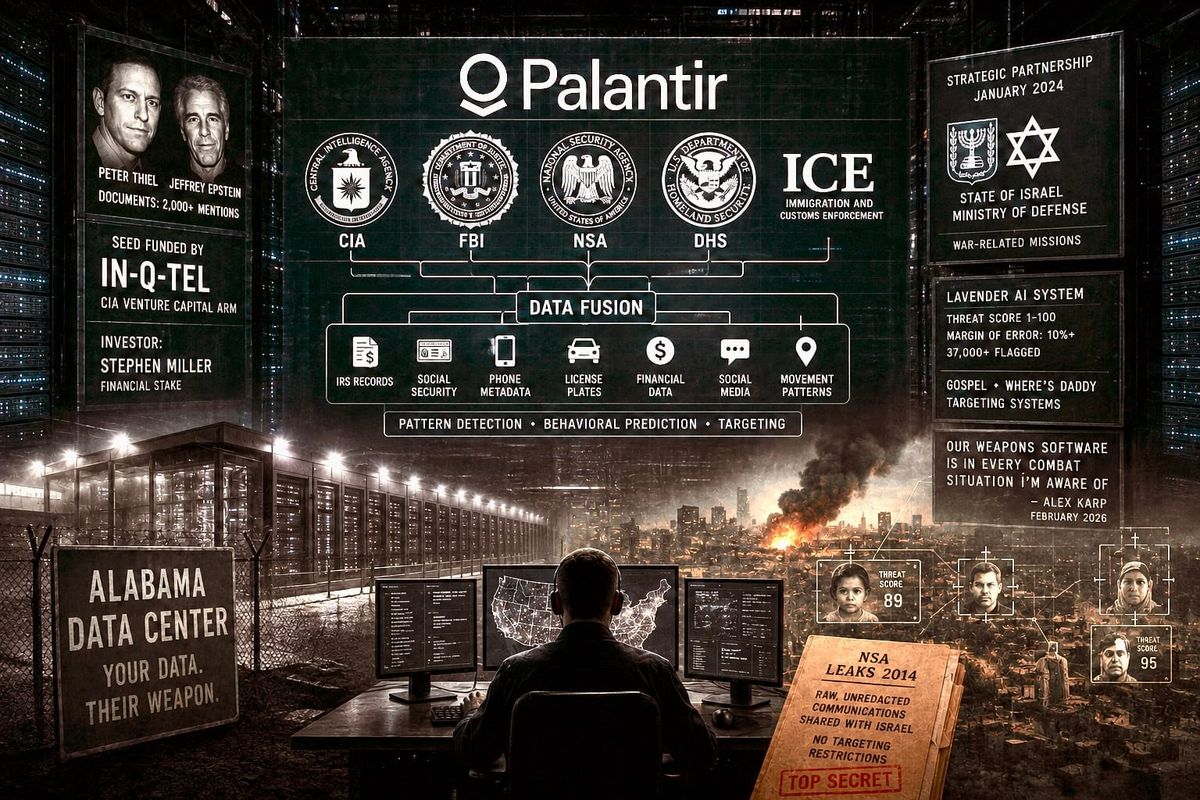
It was founded in 2003 with seed funding from In-Q-Tel — the CIA's venture capital arm. Its first significant customer was the CIA. Its founders include Peter Thiel, whose name appears in the Jeffrey Epstein documents more than 2,000 times. One of its current investors is Stephen Miller — the architect of the current administration's immigration policy — who holds a documented financial stake in the company whose technology executes that policy.

Its federal contracts grew from $4.4 million in 2009 to $541 million in 2024 to $970 million in 2025. Its stock surged 200% in a year. Its CEO was the highest-paid executive in America in 2024.
It holds active contracts with the CIA, FBI, NSA, DHS, the National Reconnaissance Office, U.S. Cyber Command, ICE, and local law enforcement agencies including LAPD and NYPD.
In January 2024, its co-founders flew to Tel Aviv and signed a strategic partnership with Israel's Ministry of Defense to provide technology for, in their own words, "war-related missions."
The company is Palantir. And the data centers being proposed for Alabama communities are part of the infrastructure it runs on.
What Palantir Actually Does
Palantir's core product is data fusion — pulling information from sources that subjects don't know are connected and integrating them into a single profile that enables pattern detection, behavioral prediction, and targeting at scale.
For immigration enforcement, that means pulling IRS records, Social Security files, passport records, license plate data, phone metadata, social media activity, movement patterns, and financial transactions into a single operational picture. ICE's own contract justification stated that Palantir "remains the sole provider capable of meeting the specific needs and requirements of ICE" with "deep institutional knowledge of ICE operations over more than a decade of support." The ImmigrationOS platform, awarded a $30 million sole-source contract in April 2025, has since expanded to over $145 million. ICE noted explicitly that the platform pulls from databases regardless of the veracity or accuracy of those databases.
For military targeting, the picture is different in scale but identical in architecture.
In January 2024, Palantir signed its partnership with Israel's Ministry of Defense. The agreement provided the Israeli Defense Forces access to Palantir's Gotham platform — described in Palantir's own materials as "a modern solution for efficient and responsible target management." Two AI systems sit at the core of the collaboration.
The first is called Lavender. It is an AI-powered database that sifts through phone metadata, social media activity, and movement patterns to assign individuals a threat score from 1 to 100. Investigations by +972 Magazine and Local Call revealed that early in the Gaza offensive, over 37,000 people were flagged as potential militants. Lavender operates with at least a 10% margin of error. Under standard IDF protocols, an algorithmic high score is sufficient to authorize a lethal strike.
The second is called Gospel. It generates target lists for neighborhoods and infrastructure. A third system, called Where's Daddy, alerts forces when a flagged individual enters their family home.
A UN Special Rapporteur report found reasonable grounds to believe Palantir supplied the AI platform powering all three systems. CEO Alex Karp said in February 2026 that "our weapons software is in every combat situation I'm aware of."
In November 2025, American and German military personnel were documented in front of a screen displaying Palantir software at a coordination center in Israel.
The Data That Feeds It
The surveillance data feeding Palantir's algorithms didn't materialize from nowhere. Documents leaked by Edward Snowden in 2014 revealed that the NSA had been secretly providing Israel with raw, unredacted communications between Palestinian Americans and their relatives in Gaza and the West Bank — without any targeting restrictions. That was 2014. Before Palantir's IDF partnership. Before the Lavender system. The data pipeline between American surveillance infrastructure and Israeli military intelligence is more than a decade old.
This matters for Alabama residents for a specific reason. The same architecture that fuses immigration records, phone metadata, and movement data for ICE enforcement — and that was already sharing American communications data with Israeli military intelligence in 2014 — is the same architecture that will process the data generated by the behavioral modification infrastructure documented in Parts 1 and 2 of this series.
The neuromarketing data. The dream incubation response profiles. The neural data collected by consumer brain-computer interface devices, 96.7% of which — per a 2024 Neurorights Foundation audit — reserve the right to transfer that data to third parties with no meaningful limits, no encryption requirement, and no breach notification standard.
Third parties. Like Palantir. Like the entities Palantir integrates with. Like foreign military intelligence services with whom American intelligence already has documented data-sharing relationships.
You opted into a sleep tracker. Your neural response data went to a third party. The third party integrated it into a platform that shares data with a foreign military. Under legislation currently moving through Congress, that relationship is about to become permanent and legally unreachable by any future President.
The Question Nobody Is Asking About Accountability
We already have documented evidence of what AI systems do when they make mistakes in high-stakes environments.
AI diagnostic systems in radiology have produced false positives and false negatives at rates that would be unacceptable from a human physician — and when they do, the legal question of who is liable remains genuinely unsettled. Is it the hospital that deployed the system? The company that built it? The programmer who wrote the algorithm? The answer varies by jurisdiction and by case, and in many instances nobody is held accountable in any meaningful way because existing legal frameworks weren't built for decisions made by machines.
Automated medication dosing systems have produced errors. Sepsis prediction algorithms have shown documented racial bias producing measurably worse outcomes for Black patients. Risk assessment tools used in criminal sentencing have been shown to systematically over-predict recidivism for Black defendants. In each of these cases the accountability gap is the same: a machine made a consequential decision, something went wrong, and the existing legal architecture struggled to assign responsibility to any specific person or entity.
Now consider what Lavender does. It assigns threat scores from 1 to 100 based on phone metadata, social media activity, and movement patterns. It operates with a documented 10% margin of error. Under standard protocols, an algorithmic high score is sufficient to authorize a lethal strike. At the scale documented in Gaza — 37,000 people flagged — a 10% error rate means thousands of people targeted who posed no threat by any reasonable standard.
When a radiology AI misreads a scan, a patient may receive unnecessary treatment. When a targeting AI with a 10% error rate authorizes a lethal strike, people die. And the accountability question is identical in structure: who is legally responsible when the machine is wrong?
The answer, under current frameworks, is effectively nobody. Not the company that built the system. Not the military commander who deployed it. Not the government that contracted for it. The machine made the decision. The machine has no legal personhood. The gap between the decision and accountability is, by design, unbridgeable.
If we cannot get AI systems to reliably manage insulin dosing or radiology reads or recidivism prediction without consequential errors — and we demonstrably cannot — why are we building permanent legal frameworks that integrate these same categories of systems into acts of war, with no settled accountability structure for what happens when they are wrong?
That is not a rhetorical question. It is the question that should be asked at every meeting where data center approvals are being considered — because the facilities being proposed for Alabama communities are part of the processing infrastructure these systems run on. The accountability gap doesn't stay in a server room in Virginia. It runs through whatever facility your county commission approves.
Stephen Miller currently serves as a senior White House official and is the primary architect of the administration's immigration enforcement policy. He holds a documented financial stake in Palantir — the company whose technology executes that policy at the contract level.
That is not an allegation. It is a documented financial interest in a company that directly profits from policy decisions Miller is designing.
The contract value of Palantir's ICE work has expanded from $30 million to over $145 million during the period Miller has held his current position. Investors on Palantir's earnings calls have expressed frustration that detention numbers — currently over 70,000 — aren't as high as they'd hoped, with some expecting 100,000. Shareholders pushing for more human beings detained because the volume affects their quarterly return — and a senior White House official with a financial stake in the company that profits from the detention — is the documented situation as it currently stands.
The Huawei Contradiction
In 2019, President Trump signed an Executive Order declaring a national emergency and directing the Commerce Department to bar transactions with companies posing national security risks. Commerce Secretary Wilbur Ross stated explicitly that "under President Trump's leadership, Americans will be able to trust that our data and infrastructure are secure."
The specific threat named was Huawei. The specific danger identified was that Chinese telecommunications equipment embedded in American infrastructure could be used by the Chinese state to access American networks, harvest data, and surveil the population.
That concern was legitimate. It remains legitimate.
But by January 2026, the same administration had fundamentally shifted U.S. semiconductor policy, allowing exports of advanced AI chips to China. The concern about Huawei accessing American networks did not go away. The financial incentive to reverse the policy simply outweighed it.
Meanwhile, the neural data infrastructure being built and scaled right now — the consumer brain-computer interface devices, the sleep tracking apps, the dream incubation platforms, the neuromarketing data collection apparatus — operates with no equivalent protection. A 2024 Neurorights Foundation audit found that 96.7% of consumer neurotechnology companies reserve the right to transfer brain data to third parties. Fewer than 20% mention encryption. Only 16.7% commit to breach notification.
China's brain-computer interface market, valued at $85.5 million in 2024, is projected to reach $242 million by 2030, entirely state-backed. Beijing, Shanghai, Guangdong, and Sichuan provinces have all issued action plans targeting large-scale commercial BCI deployment by 2030. Sichuan alone is targeting 3,000 invasive BCI surgeries per year. U.S. Senators have stated explicitly that Americans' neural data must never be transferred to foreign adversaries — and that if an individual uses a BCI device, they should not later learn their brain signals trained an AI system or were sold to third parties.
Should not. But currently can. Legally. Tonight.
The threat named in 2019 was: Chinese technology in American infrastructure could let Beijing access what Americans are doing.
The infrastructure being built and scaled right now would let Beijing — or any other party on the receiving end of a third-party data transfer — access what Americans are dreaming.
Same vulnerability. Bigger stakes. No national emergency declaration.
What This Means for the Data Centers Coming to Alabama
The data centers being proposed for Alabama communities don't come with a label that says "Palantir processes data here" or "this facility is part of an intelligence-sharing architecture that includes a foreign military." They come with an economic development pitch and a tax incentive package and a jobs number.
But the companies proposing these facilities operate within an ecosystem — the same ecosystem documented in this part of the series. CIA-seeded data integration platforms. Foreign military intelligence partnerships. Neural data collection with no meaningful transfer limits. A conflict of interest between policy design and corporate profit sitting at the senior level of the executive branch.
The data center in your community doesn't have to have Palantir's name on the door to be part of the infrastructure Palantir runs on. It just has to be connected to the same network. And they all are.
The questions your county commission needs to ask — and almost certainly hasn't — are not just about jobs and tax revenue. They are about what data the facility processes, who has access to it, what the transfer policies are, what foreign government partnerships the owner maintains, and what legal framework, if any, governs what happens to the data generated by Alabama residents once it enters that facility.
Those questions have answers. Your elected officials should be requiring them before approving anything.
Part 4: Section 219 and the Sovereignty Question — The House just passed legislation permanently merging American military and intelligence infrastructure with a foreign government under active international arrest warrants, and buried it in 1,100 pages so it wouldn't get a standalone vote. Here's what that means for every piece of data being collected in Alabama right now.
Alicia Haggermaker is an investigative journalist, systems analyst, and community organizer based in Huntsville, Alabama. She publishes at Unprecedented Times (unprecedentedtimes.org) and is the founder of the Mycelium Network — a sovereign community coordination platform built as an alternative to the infrastructure this series documents.
unprecedentedtimes.org | mycelium.unprecedentedtimes.org
Sources:
Palantir Technologies Wikipedia entry and SEC filings; In-Q-Tel founding documentation; OpenSecrets reporting on Palantir lobbying and campaign contributions (2025–2026); American Immigration Council reporting on Palantir ImmigrationOS (2025); ICE ImmigrationOS sole-source contract justification (April 2025); +972 Magazine and Local Call investigation into Lavender AI system (2024); The Nation investigation into Palantir targeting systems (2024); UN Special Rapporteur Francesca Albanese report on Palantir and IDF AI systems (2024); Bloomberg reporting on Palantir-Israel strategic partnership (January 2024); Palantir CEO Alex Karp statement on weapons software (February 2026); Who Profits documentation of Palantir at Kiryat Gat coordination center (November 2025); Edward Snowden NSA-Israel communications sharing documentation (2014); NeuroRights Foundation consumer BCI audit (2024); MIND Act, Sens. Cantwell, Schumer, Markey (September 2025); China BCI market analysis, AInvest (August 2025); Trump executive order on telecommunications security (May 2019); Commerce Department Huawei Entity List action (May 2019); BISI analysis of Trump AI chip export policy reversal (January 2026); The Appeal reporting on Palantir investor earnings calls (2026); Stephen Miller Palantir financial stake documentation; Assembled With Dependency series, AL Politics (2026); They Weren't Hiding It, Unprecedented Times (2026); Follow the Yellow Brick Road, Unprecedented Times (2026).
The Assembled with Dependency series may be read at the following links: Part 1 — Part 2 — Part 3 — Part 4.
Opinions do not reflect the views and opinions of ALPolitics.com. ALPolitics.com makes no claims nor assumes any responsibility for the information and opinions expressed above.