
What This Means for You, Specifically, in Alabama
The Infrastructure Is the Argument — Part 5 of 6. Guest Opinion by Alicia Haggermaker
Guest Opinion by Alicia Haggermaker
This is Part 5 of a six-part series on Alabama's data center buildout and what it actually enables. Part 1 established what the infrastructure is actually for. Part 2 traced the doctrine behind it. Part 3 documented who controls what it collects. Part 4 documented what Congress just did to make the foreign intelligence-sharing architecture permanent. This part asks the question the previous four parts have been building toward: what does all of this mean for you, specifically, living in Alabama, right now?
Here is a question worth sitting with before you read the rest of this piece.
Have you ever posted on social media about the conflict in Gaza? Shared an article critical of Israeli military policy? Attended a protest of any kind? Donated to a humanitarian organization operating in a conflict zone? Sent a private message to a friend or family member expressing concern about civilian casualties?

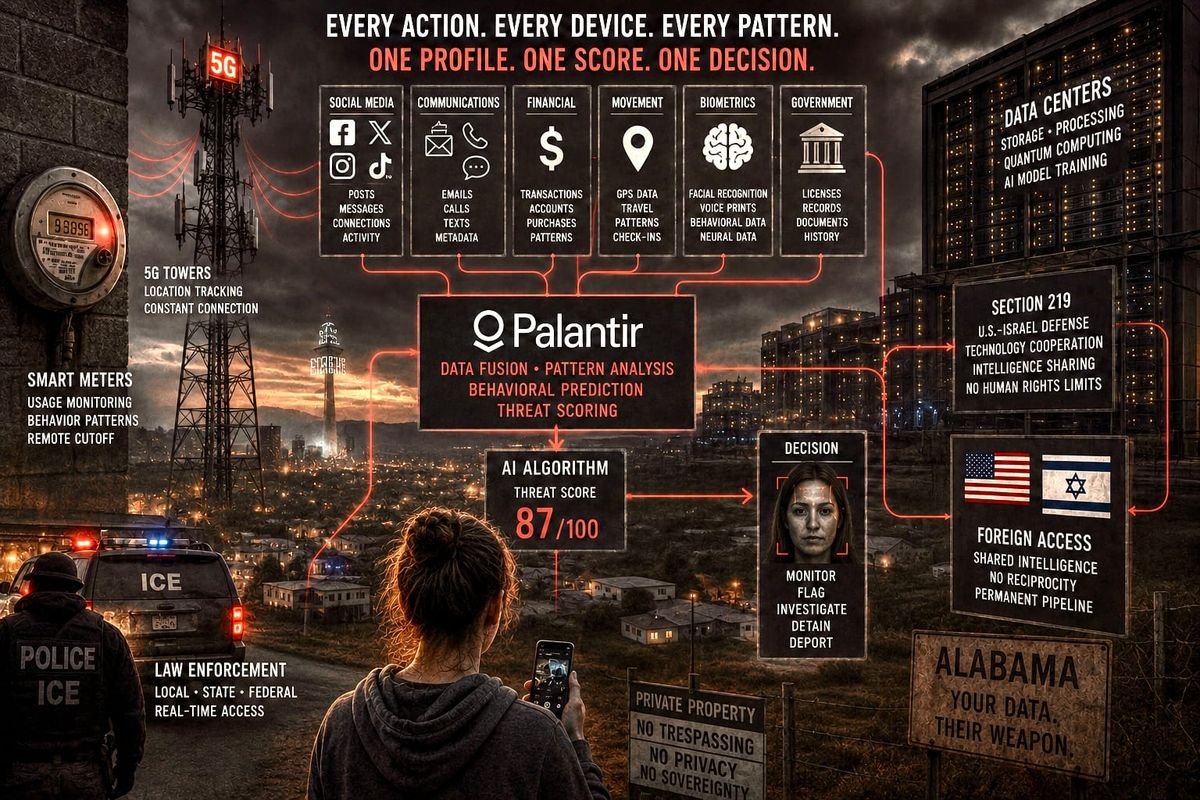
If any of those answers is yes — and for a significant portion of Alabama residents they will be, across every political persuasion — then you have generated data that feeds into an AI targeting system called Lavender, documented in Part 3 of this series, that assigns individuals threat scores from 1 to 100 based on exactly that kind of information.
And under Section 219 of the House-passed FY2027 NDAA — documented in Part 4 — the intelligence-sharing framework that gives a foreign military access to the outputs of that system is on its way to becoming permanent American law.
This is not hypothetical. Every piece of infrastructure required to make it operational already exists. This part of the series explains how they connect to your daily life in Alabama.
The Surveillance Architecture Already Running
The personal surveillance infrastructure documented in this series is not future technology. It is operational now.
Your social media activity is already being monitored at scale. Palantir's data fusion platforms — the same ones running ICE enforcement operations documented in Part 3 — pull from social media activity, phone metadata, movement patterns, financial transactions, and communication records across sources that subjects don't know are connected. The NSA has been sharing raw American communications data with Israeli military intelligence since at least 2014, per documents leaked by Edward Snowden. That data feeds the same algorithmic targeting architecture Palantir now formally supports through its Israeli Ministry of Defense partnership.
Your movement is already being tracked. GEO Group's subsidiary BI Incorporated — which began as a dairy cow tracking service in Boulder, Colorado in 1978 — now operates the nation's largest electronic monitoring system, tracking approximately 180,000 people using GPS ankle monitors, a smartphone app called SmartLINK that collects geolocation, phone contacts, vehicle information, facial images, and voice prints, and a device called VeriWatch that looks like a smartwatch, tracks location, scans faces for biometric authentication, and cannot be removed without triggering an alert. This system was built for immigration monitoring. The architecture that runs it is the same architecture that processes all the other data documented in this series.
Your financial behavior is already being profiled. The same Palantir platforms that integrate immigration records integrate financial transaction data. The CBDC ban currently in effect expires in 2030 — at which point the infrastructure that has spent four years entrenching private stablecoin systems (exempt from the ban) as the dominant digital currency architecture will be fully in place. Post-quantum encryption mandates lock in around the same time. By 2030, financial behavior will be fully integrated into the same data profile that already includes your communications, your movement, your social media activity, and your biometric information.
Your neural data is already being collected. A 2024 Neurorights Foundation audit found that 96.7% of consumer neurotechnology companies — the companies behind the sleep trackers, the fitness monitors, the consumer brain-computer interface devices on the market right now — reserve the right to transfer your brain data to third parties with no meaningful limits, no encryption requirement, and no breach notification standard. If you use a device that monitors your sleep, your heart rate variability, your stress response, or your cognitive state, that data is being collected and transferred to parties you did not specifically consent to share it with.
What Facebook Already Proved
In 2014, Facebook ran a psychological experiment on 689,000 users without their knowledge or consent. Researchers manipulated News Feeds to show users either predominantly positive or predominantly negative emotional content, then measured whether it changed the emotional tone of users' own subsequent posts.
It did. They published the results in a peer-reviewed academic journal.
What Facebook confirmed — on nearly 700,000 unwitting human subjects — is that algorithmically delivered emotional content reliably shifts the emotional state and subsequent behavior of the recipient. Then they kept doing it. For years. On two billion people worldwide, including tens of millions of Alabama residents.
What those years produced is the most detailed behavioral response database in human history. What makes you angry. What makes you afraid. What makes you share. What makes you disengage. What emotional content produces what behavioral response in which demographic, in which region, at which political moment.
That database is the targeting intelligence for a dream incubation system optimized not for beer sales but for behavioral influence at population scale. The neuromarketing industry has spent years mapping which emotional stimuli produce which neurological responses. The dream incubation apparatus documented in Parts 1 and 2 delivers content into the precise neurological window where the brain is maximally receptive and the critical mind is offline. The data centers being proposed for Alabama communities are the processing backbone that makes deploying it at population scale possible.
They did not need a laboratory. They had two billion people who told the algorithm exactly how their nervous system responds to every category of emotional stimulus, voluntarily, for years. And they stored all of it.
What Public Speech Now Means
If you have spoken publicly about Gaza — posted on Facebook, written on Substack, spoken at a community meeting, published in a local paper — that speech is already part of a data profile that feeds into systems documented in this series.
Lavender assigns threat scores based on phone metadata, social media activity, and movement patterns. It flagged 37,000 people as potential militants with a documented 10% margin of error — meaning at that scale, thousands of people were flagged who posed no threat by any reasonable standard. The system does not distinguish between Palestinian civilians and Alabama residents. It processes data. The data you generate through your speech, your associations, your online activity, and your physical movements is the same category of data the system is built to process.
Under Section 219, the intelligence-sharing framework that connects American surveillance infrastructure to Israeli military intelligence becomes permanent and legally unreachable by any future American president. The foreign military whose AI targeting system already processes this category of data would have a legislatively protected, permanently embedded relationship with the American intelligence apparatus that collects it.
Marjorie Taylor Greene — not exactly a progressive voice — described the House vote on Section 219 as one that "will give a list of names of every Member of Congress who betrayed America, committed treason, and sold out the American people to a foreign country."
She was talking about the same vote every Alabama Republican House member voted yes on.
What Private Speech May No Longer Mean
The distinction between public and private speech is eroding in ways that most Alabama residents have not been told about.
Your private messages on social media platforms are subject to the same data collection frameworks as your public posts — and in some cases more so, because private message data is more behaviorally specific and therefore more valuable for targeting purposes. The NSA's raw communications sharing with Israeli military intelligence documented by Snowden was not limited to public statements. It covered communications broadly.
Your private conversations on messaging apps that claim end-to-end encryption are protected to the degree that encryption holds — and post-quantum computing, projected to achieve practical capability around 2030, is specifically designed to break the encryption standards currently protecting those communications. The post-quantum encryption mandate that locks in around 2030 will protect government communications with new standards. Your private messages from the years before that transition will remain vulnerable to decryption by any actor with access to quantum computing capability — which China, per documented state investment, is actively developing.
And then there is the layer that has no historical precedent.
Your neural speech — what your brain does while you sleep, what emotional responses you have to political content, what your nervous system registers as threat or safety or trust — is being collected by consumer devices right now. It is being transferred to third parties by 96.7% of the companies collecting it. It will be processed by the data centers being built in your community. And it will enter an intelligence-sharing architecture that, under Section 219, includes a foreign military whose AI systems are already trained to make lethal decisions based on exactly this category of behavioral and neurological data.
You did not consent to any of this individually and specifically. You may have clicked through a terms-of-service agreement. That is the entirety of the consent structure currently governing the collection and transfer of your neural data to parties operating under foreign military jurisdiction.
The 2030 Convergence
This series has documented several threads that converge around 2030. It is worth naming them together because individually each looks like a policy detail. Together they look like a timeline.
The CBDC ban expires December 31, 2030 — not a privacy win but a privatization mechanism. It removes the Federal Reserve as a competitor to private stablecoin issuers while Tether and Circle — which currently control approximately 87% of total stablecoin market capitalization — entrench themselves as the dominant digital dollar infrastructure. By 2030, when the ban expires, those private systems will be so embedded that a government re-entry into digital currency will be nearly impossible to achieve. The ban isn't a permanent rejection of digital currency control. It's a four-year carve-out that privatizes the infrastructure before the government builds a public version.
Post-quantum encryption mandates lock in around 2030 — protecting government communications going forward with new standards. But everything encrypted before that transition remains vulnerable to quantum decryption by any actor with that capability. China is actively developing it. The data centers being built now store data that will be decryptable by quantum systems within the 2030 timeframe. Your private communications from today, stored in those facilities, are not protected by the encryption standards being mandated for government use.
This is where the data centers connect directly to the After 2030 convergence. The facilities being proposed for Alabama communities are not just processing infrastructure for today's data. They are the storage backbone for data that will be readable by quantum systems within the decade. Every communication, every financial transaction, every neural response profile, every biometric record stored in those facilities exists within a vulnerability window that closes only for government systems — not for yours.
The sitting President has posted on Truth Social asking "SHOULD I TRY FOR A FOURTH TERM?" — a constitutionally prohibited question he has explained by arguing his 2020 loss was illegitimate, making this term his third and any future run his fourth. Whatever one makes of that framing, a President openly floating unconstitutional continuation of power while the behavioral modification infrastructure, consolidated surveillance architecture, permanent foreign intelligence sharing framework, and data center buildout are all locking in simultaneously is context that belongs in any honest accounting of what 2030 represents.
The "you voted for this" narrative is the endgame framing — where every decision made in the 2025-2030 period gets attributed back to democratic choice, insulating the architects from accountability. You supported Trump. You wanted CBDC banned. You wanted private crypto. You wanted the data centers. You wanted the elections secured. You made these choices. Now deal with the consequences.
That accountability deflection is only possible if the public layer — the County Commission, the State legislature, the voters — were actually informed about what they were choosing. The argument of this series is that they weren't. That's the gap between what communities are told and what the infrastructure actually enables. And it's the gap that closes by 2030 if the questions in this series aren't asked now.
By 2030, if the current trajectory holds, the infrastructure will house your neural responses, your financial transactions, your movement patterns, your communication metadata, your biometric profile, and your sleep architecture — integrated, processed, transferable to parties operating under foreign military jurisdiction, quantum-readable by adversarial state actors, and governed by a legal framework that no future president can meaningfully adjust.
That is not a prediction. It is a description of what is being built right now, documented at every step in this series, converging on a timeline that nobody in the Bessemer meeting or the county commission or the state legislature has been asked to evaluate.
For the full documented analysis of the 2030 convergence, see the companion piece at Unprecedented Times:
The Personal Question
This series has been careful throughout to document rather than speculate, to source every claim, and to present the argument in terms that cut across partisan identity rather than appealing to any single political tribe.
But there is a personal dimension to this that documentation alone cannot fully convey.
I am a journalist in Huntsville, Alabama. I have written extensively about data center infrastructure, semiconductor supply chains, water rights, community sovereignty, and the institutional history of behavioral modification programs in the United States. I have published pieces that ask uncomfortable questions about powerful institutions and powerful people. I have done so under my own name, on my own platform, in my own community.
The infrastructure documented in this series processes exactly the kind of speech I produce. The targeting systems documented in Part 3 are trained on exactly the kind of data my work generates. The intelligence-sharing framework documented in Part 4 would give a foreign military's AI targeting apparatus permanent, legally protected access to the American intelligence infrastructure that collects that data.
I am not saying I am a target. I am saying the architecture does not ask whether you deserve to be one. It processes data. It assigns scores. It flags patterns. And it does all of this in the absence of any meaningful legal framework governing what happens to the outputs — or who sees them — once they enter a permanently integrated foreign intelligence-sharing arrangement.
If that concerns you — and it should concern you regardless of your politics, your position on Gaza, or your opinion of any particular foreign government — then Part 6 of this series is the one worth reading most carefully.
Because this does not end with despair. The geese came back. And there are things Alabama residents, Alabama communities, and Alabama legislators can actually do about this right now, before the infrastructure is fully built and the decisions are made for them.
Part 6: What You Can Actually Do About It — the economic development infrastructure already exists, it's already being used by Alabama people on current infrastructure, and the model for sovereign community technology that doesn't hand your data to foreign military intelligence is already running in this State.
Alicia Haggermaker is an investigative journalist, systems analyst, and community organizer based in Huntsville, Alabama. She publishes at Unprecedented Times (unprecedentedtimes.org) and is the founder of the Mycelium Network — a sovereign community coordination platform built as an alternative to the infrastructure this series documents.
unprecedentedtimes.org / mycelium.unprecedentedtimes.org
Sources:
NeuroRights Foundation consumer BCI audit (2024); Palantir ImmigrationOS documentation and ICE contract filings (2025–2026); GEO Group BI Incorporated SmartLINK and VeriWatch product documentation; Edward Snowden NSA-Israel raw communications sharing documentation (2014); +972 Magazine and Local Call investigation into Lavender AI system (2024); Kramer et al., "Experimental evidence of massive-scale emotional contagion through social networks," PNAS (2014); Military.com reporting on NDAA Section 219 House vote (July 22, 2026); Marjorie Taylor Greene statement on Section 219 vote (July 2026); MIND Act, Sens. Cantwell, Schumer, Markey (September 2025); China BCI market analysis, AInvest (August 2025); Arnold & Porter neural data privacy regulation advisory (July 2025); CSIS "When Thought Becomes Data: The MIND Act and the Coming Debate Over Neurotechnology" (November 2025); MIT Media Lab Dormio and Targeted Dream Incubation project documentation; American Marketing Association Future of Marketing study (2021); Assembled With Dependency series, AL Politics (2026); They Weren't Hiding It, Unprecedented Times (2026); Follow the Yellow Brick Road, Unprecedented Times (2026); Show Me On This Doll Where The America First Parts Are, Unprecedented Times (2026); After 2030, Unprecedented Times (2026).
The Assembled with Dependency series may be read at the following links: Part 1 — Part 2 — Part 3 — Part 4.
Opinions do not reflect the views and opinions of ALPolitics.com. ALPolitics.com makes no claims nor assumes any responsibility for the information and opinions expressed above.