What You Can Actually Do About It
The Infrastructure Is the Argument — Part 6 of 6. Guest Opinion by Alicia Haggermaker
Guest Opinion by Alicia Haggermaker
This is the final part of a six-part series on Alabama's data center buildout and what it actually enables. Part 1 established what the infrastructure is actually for. Part 2 traced the doctrine behind it and the moment the private technology sector formally merged with the military. Part 3 documented who controls what it collects. Part 4 documented what Congress just did to make the foreign intelligence-sharing architecture permanent. Part 5 brought it home to Alabama specifically — your speech, your data, your community, your Senators. This part is about what you can actually do.
This series has documented a lot of things that are difficult to sit with.
A seventy-year institutional lineage running from MKUltra through MindWar to DARPA's current open neurotechnology programs. A CIA-seeded surveillance company formally partnered with a foreign military intelligence apparatus running AI targeting systems on exactly the category of data your phone, your sleep tracker, and your social media account generate every day. A Congress that buried a permanent military merger with a foreign government under active international arrest warrants in eleven pages of a 1,100-page bill and blocked a bipartisan amendment to remove it from even receiving a floor vote. A group of technology executives who skipped twenty-two military ranks to become Lieutenant Colonels while simultaneously running the companies that own the infrastructure this series documents. Data centers coming to Alabama communities whose economic development pitch leaves out everything documented in the previous five parts.

That is a lot. And it would be easy to read it and feel like the scale of it makes individual or community action pointless.
It isn't. Here is why — and here is what you can actually do.
The Infrastructure Already Exists — and It's Already Working
The first thing worth understanding is that the alternative to corporate-owned, military-integrated, foreign-intelligence-accessible data infrastructure is not theoretical. It exists. It is running right now in Alabama. And it was built by one person on a refurbished computer.
The Mycelium Network is a self-hosted, sovereign community coordination platform built and maintained in Huntsville, Alabama on a refurbished Dell OptiPlex served through a Cloudflare tunnel. It hosts a Maker's Guild, scheduling and inventory systems, environmental monitoring dashboards, a whistleblower forum, mesh radio integration for off-grid communication, and community coordination infrastructure for multiple Alabama communities. It is expanding to a Cullman regional node with an independent operator. It does not run on Chinese components feeding a Palantir data integration architecture. It does not transfer its users' data to third parties with no meaningful limits. It is not subject to a permanent intelligence-sharing framework with a foreign military.
It was built with AI tools on existing infrastructure. The same infrastructure Alabama journalists, entrepreneurs, educators, small business owners, and community organizers are using right now to do things that a year ago would have required teams, budgets, and technical expertise most people don't have.
The economic development argument for new data centers assumes that the infrastructure required for Alabama communities to thrive doesn't exist yet. It does. We are using it. The expansion being proposed is not for us. As this series has documented from Part 1 forward — the marginal user of the next hundred data centers is not a person trying to do something productive with tools that already work. It is the behavioral modification apparatus, the neural data processing pipeline, and the targeting architecture that requires orders of magnitude more capacity than any individual or small business will ever need.
Sovereign community infrastructure is not a utopian concept. It is a documented operational reality already running in Alabama. The Mycelium model is replicable at the regional level by any community that wants infrastructure that serves its members rather than harvesting them.
The Local Lever Is Real
Data center siting decisions happen at the local level. That is not a small thing. It is the most important thing in this series, practically speaking, because it means the decision is being made by elected officials who answer directly to the people reading this piece.
Zoning approval. Water rights allocation. Power access agreements. Tax incentive packages. Economic development designations. Every one of these decisions goes through a local body — a county commission, a city council, a planning board — whose members were elected by your neighbors and can be reached by phone, by email, by showing up at a public meeting, and by voting.
Before any Alabama community approves a data center, its elected officials should be requiring answers to the following questions — in writing, on the record, before any vote:
Who owns this facility, and what is the complete corporate ownership structure including any foreign ownership stakes?
What categories of data will this facility process, store, or transfer?
Who has access to that data, under what legal framework, and what foreign government partnerships does the owner maintain?
What are the facility's water consumption commitments and what happens to residential water service if those commitments create supply constraints?
What are the power consumption commitments and what is the documented impact on residential utility rates?
What legal framework governs what happens to data generated by Alabama residents once it enters this facility — and specifically, does the owner company reserve the right to transfer that data to third parties, including parties operating under foreign military jurisdiction?
What economic benefits accrue specifically to the local community — not to the state, not to the company, not to the tax base in the abstract — and on what timeline?
Those questions have answers. Requiring them before approving anything is not obstructionism. It is the basic due diligence that elected officials owe the communities they represent.
The Legislative Lever Is Real and Currently Open
Alabama has passed no neural data rights legislation. Minnesota has. California has. Colorado has. Montana has. The MIND Act — introduced in September 2025 by Senators Cantwell, Schumer, and Markey — would direct the FTC to establish a framework governing neural data collection, transfer, and use at the federal level, and would explicitly prohibit federal agencies from purchasing neurotechnology that processes neural data in harmful ways.
These are real, existing legislative models. Alabama legislators could act on them right now — before the infrastructure being proposed for Alabama communities is built and the decisions about what happens to Alabama residents' neural data are made by corporate terms-of-service agreements that nobody reads.
The state legislature should be asked — on the record, before the next session — whether Alabama residents have a right to know when their neural data is being collected, who it is being transferred to, and under what legal framework that transfer is governed. The answer should be yes. It currently isn't, because no one has passed the law that says so.
Senator Britt and Senator Tuberville have not yet voted on Section 1217 — the Senate's parallel provision to Section 219 documented in Part 4. The Senate NDAA remains stalled as of publication. That window is real. Their contact information is at senate.gov. The question they should be asked is specific: do you believe permanently merging American military and intelligence infrastructure with a foreign government under active international arrest warrants, in ways no future president can reverse, serves the interests of Alabama residents? That question deserves a public answer before the conference process produces a final bill.
The Ping Pong Problem — and How to Break It
This series has noted the ping pong effect of partisan accountability throughout — when one party passes something indefensible, the other party votes against it, and then the tables turn and the dynamic reverses. The infrastructure keeps building regardless of which party holds the gavel because the structural incentives that drive it don't change with election results.
Breaking that pattern requires something different from partisan voting. It requires asking questions that don't have partisan answers.
Is it in Alabama's interest to host infrastructure that processes its residents' neural data with no meaningful transfer limits? That is not a Republican or Democratic question.
Is it in Alabama's interest to approve data centers built on supply chains the government formally identified as national security threats? That is not a Republican or Democratic question.
Is it in Alabama's interest to have its Senators vote for legislation that permanently embeds a foreign government's defense technology into American military research and acquisition in ways no future election can change? That is not a Republican or Democratic question.
The people asking these questions at the Bessemer meeting, at the county commission, at the state legislature, and in the letters they write to their senators don't have to agree on anything else to agree on those. That is the coalition the infrastructure's proponents are least equipped to handle — not a partisan opposition, but a community that simply wants answers before it consents to hosting something it was never fully told about.
The Sovereignty Argument as Organizing Tool
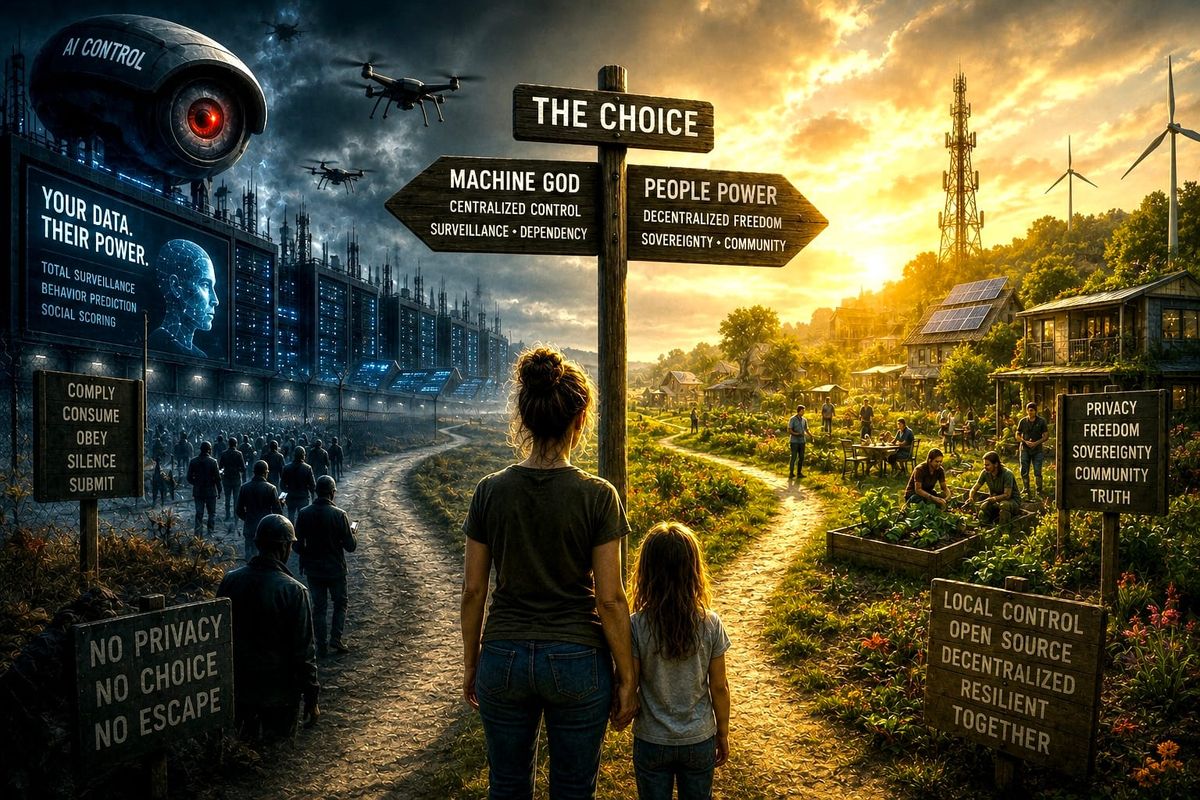
The through-line of this entire series — both Assembled With Dependency and The Infrastructure Is the Argument — is sovereignty. Who controls the infrastructure. Who controls what it collects. Who controls the legal framework governing both. And whether the communities hosting that infrastructure had any meaningful say in those decisions.
Sovereignty is not a partisan concept. It is the foundational premise of self-governance — that the people affected by decisions have a legitimate voice in making them. The data center pitch that arrives in a community without disclosing what the infrastructure is actually for, who controls what it collects, and what foreign military partnerships the owner maintains is a sovereignty violation before a single server goes live. The legislation that permanently merges American military and intelligence infrastructure with a foreign government without a standalone vote is a sovereignty violation on a national scale.
Naming it that way — not as a left issue or a right issue but as a sovereignty issue — is what makes the coalition possible. Veterans who understand what it means to have twenty-two ranks of military service bypassed in a ceremony. Parents who understand what it means to have their children's neural data transferred to third parties with no encryption requirement. Small business owners who understand what it means to compete against infrastructure built with tax incentives they didn't receive and water rights they didn't get to contest. Community organizers who understand what it means to have a billion-dollar facility sited in their neighborhood without a meaningful public process.
All of those people are in Alabama. All of them have a legitimate stake in the questions this series has asked. None of those stakes require agreement on anything partisan to be real.
The Geese
There is a homeowner's association near here that gassed Canadian geese for leaving droppings on their grass.
More geese showed up. As geese do. As nature does. As the unmanaged, inconvenient, uncontrollable real always does regardless of what we spend to keep it out.
The people building the infrastructure documented in this series are running the same losing operation against the same opponent. They can build the data centers. They can commission the technology executives. They can bury the legislation in 1,100 pages. They can pipe Coors beer into your sleeping mind and call it a dream study. They can assign you a threat score based on a Facebook post and call it security.
But the questions don't go away. The communities don't stop existing. The veterans who earned their ranks through years of service don't forget what it means to have someone skip twenty-two of them. The parents don't stop wanting to know what happens to their children's neural data. The county commissioners don't have to approve anything they haven't been given full information about.
Kansas is still there. It was always there.
The data centers need your community's water. They need your community's power. They need your community's zoning approval. And they need your community's silence.
The first three are negotiable at the local level, in public meetings, by elected officials who answer to you.
The fourth one is entirely up to you.
The Questions Nobody Is Asking
There are things we know. There are things we can document. And then there are questions that the documented facts require us to ask — even when, especially when, nobody in an official position seems to be asking them.
The people whose network funded the biotech research pipeline documented in these pages include individuals with documented histories of trafficking and abusing children. That is not alleged. It is adjudicated. Jeffrey Epstein was a convicted sex offender who ran a documented trafficking operation that implicated powerful people across science, finance, government, and academia.
So here is a question worth sitting with before the next data center gets approved in your community:
Do we trust people with that documented moral record with science that maps, monitors, and potentially shapes what human beings think, consume, and believe?
And beyond that specific network — a broader question that Lord Acton answered in 1887 and that every generation has had to relearn the hard way:
Do we trust anyone with this category of power?
Not because the people currently holding it are uniquely corrupt. But because power corrupts. Absolute power corrupts absolutely. And what is being built right now — the infrastructure to reach into the hypnagogic state, to map neural responses, to collect and transfer biological data with no meaningful limits, to pipe content into the precise neurological window where human memory forms — is a category of power that has never existed before.
Previous concentrations of power could control what people did. Where they went. What they said publicly. What's being built now reaches into the substrate of thought itself. Into the biological architecture of who we are.
That is not a small thing to hand to anyone. It is not a small thing to approve at a county commission meeting without full disclosure. It is not a small thing to bury in eleven pages of a 1,100 page bill without a standalone vote.
The questions we need to be asking at the Bessemer meeting, at the state legislature, in the halls of Congress:
Who controls the applications of research funded by networks with documented ties to intelligence agencies and convicted traffickers? Who owns the patents? What happens to the data those technologies generate?
The DOJ released approximately 3 million pages of Epstein files under the Epstein Files Transparency Act — then removed 47,635 of them without notice. NPR confirmed that the removed files included FBI interviews with survivors who made allegations involving President Trump. Congressional Democrats confirmed the DOJ appears to have illegally withheld those specific documents and opened an investigation. The DOJ's stated reason was victim privacy concerns. The specific files removed — and the sequence in which they were removed and selectively restored — are documented and on the public record.
The pattern of who gets accountability and who doesn't is itself documented. The same DOJ that removed files containing allegations against a sitting president is the same DOJ running Palantir-powered immigration enforcement. The same administration that declared a national emergency over Chinese telecommunications equipment accessing American networks reversed that policy when the financial incentive changed. The same Congress that buried Section 219 in 1,100 pages without a standalone vote is the same Congress that passed the Epstein Files Transparency Act requiring full disclosure.
The same administration that removed 47,635 Epstein files — including files containing allegations against the president — simultaneously released what it described as declassified proof of 2020 election fraud in a primetime White House address four months before midterm elections. An Associated Press review found no confirmation of those claims in the released documents. Many pages were so heavily redacted that their findings were unclear. The administration used redaction to obscure what it released as evidence while using removal to obscure what it was legally required to disclose. The documents Trump presented as proof of a stolen election were more heavily redacted than the Epstein files the DOJ was required by law to release in full.
That is the documented accountability asymmetry. Redaction for the evidence you want people to believe. Removal for the evidence you don't want them to see.
Accountability is not impossible. It is being systematically managed. And the data centers being built in communities like Bessemer are part of the infrastructure that makes that management possible at scale.
We know nanoparticles respond to external signals in documented, peer-reviewed ways. We know DARPA is developing bidirectional brain-machine interfaces. We know neural data is being collected with no meaningful transfer limits. What happens when those capabilities converge? Who is studying that convergence? Who is funding it? Why is that question absent from every public conversation about the infrastructure being approved in communities across Alabama?
What is the consent framework for technologies that operate below the threshold of conscious awareness — in the hypnagogic state, in the nervous system, in the biological substrate of thought?
And the oldest question, the one that predates all of this by centuries:
Who watches the watchers?
We don't have all the answers. We're not sure anyone does. But the questions belong in the public square — at the county commission, at the state legislature, at the Bessemer meeting, and in every community being asked to host infrastructure they haven't been fully told about.
The data centers need your water. They need your power. They need your silence.
You've already given them the first two.
The third one is still yours.
This has been a six-part series. The full documented versions of every argument made in this series — with complete sourcing, additional historical context, and the companion investigation into the supply chain underlying this infrastructure — are available at Unprecedented Times. The Mycelium Network is a working example of what sovereign community infrastructure looks like when it is built to serve the people using it rather than the systems harvesting them.
If you have questions for your county commission, your city council, or your state legislators about data center approvals in your community, the questions documented in this series are a starting point. If you want your Senators on record about Section 1217 before the NDAA conference process produces a final bill, their contact information is at senate.gov.
Alicia Haggermaker is an investigative journalist, systems analyst, and community organizer based in Huntsville, Alabama. She publishes at Unprecedented Times (unprecedentedtimes.org) and is the founder of the Mycelium Network — a sovereign community coordination platform built as an alternative to the infrastructure this series documents.
unprecedentedtimes.org | mycelium.unprecedentedtimes.org
Sources:
NeuroRights Foundation consumer BCI audit (2024); MIND Act, Sens. Cantwell, Schumer, Markey (September 2025); Minnesota HF 4757 neural data rights legislation (2024); California SB 44 neural data legislation (2025); CSIS "When Thought Becomes Data: The MIND Act and the Coming Debate Over Neurotechnology" (November 2025); Arnold & Porter neural data privacy regulation advisory (July 2025); Military.com reporting on NDAA Section 219/1217 Senate status (July 2026); Congressional Research Service FY2027 NDAA status report (July 2026); Senate cloture vote on S. 4784 (July 14, 2026); Breaking Defense reporting on Detachment 201 (June 13, 2025); U.S. Army press release on Detachment 201 (army.mil, June 13, 2025); Defense One, "The Army's not sure what its new Executive Innovation Corps will actually do" (June 26, 2025); Wired reporting on Detachment 201 selection process (June 2025); Assembled With Dependency series, AL Politics (2026); They Weren't Hiding It, Unprecedented Times (2026); Follow the Yellow Brick Road, Unprecedented Times (2026); Show Me On This Doll Where The America First Parts Are, Unprecedented Times (2026); After 2030, Unprecedented Times (2026).
The Assembled with Dependency series may be read at the following links: Part 1 — Part 2 — Part 3 — Part 4.
Opinions do not reflect the views and opinions of ALPolitics.com. ALPolitics.com makes no claims nor assumes any responsibility for the information and opinions expressed above.